
A crypto-backed IBAN with a virtual card, limited to the EEA and a handful of neighbours
 Available in US
Brighty sits in an unusual corner of the crypto-card market. It is not only a card product; it is a crypto account with an IBAN, a virtual Mastercard or Visa, and an app that lets you hold and convert Bitcoin, Ethereum, USDC and a few other assets. The combination is genuinely useful for people in the European Economic Area who want a single place to hold euros, spend stablecoins, and receive SEPA payments, but several pieces of the picture are missing from the company’s own pages, and the user reviews that exist are mixed.
The conditions in this review are current as of October 28, 2026.
Verdict
Brighty scores 5.6 out of 10. It is a real, functioning product with a licensed-sounding structure and a feature set that goes beyond a simple crypto card, but the geographic reach is narrow, the physical card programme is paused, and public information about who actually issues the card and what protections users have is thin.
| Criterion | Mark | Reason |
|---|---|---|
| Who can get it | 5 / 10 | EEA-only card page; app expanded to Montenegro and Andorra; full country list not published |
| Cost | 7 / 10 | EUR 2.99 to issue a virtual card; free monthly service; in-app FX 0.6% to 0.4% on One / Plus / Pro |
| Top-up options | 7 / 10 | Bitcoin, Ethereum and USDC in the app; free incoming crypto; IBAN for SEPA; many outgoing networks |
| Reliability and complaints | 4 / 10 | Issuer not named officially; Trustpilot 3.2 from 78 reviews; recurring complaints about account closures |
| Everyday use | 5 / 10 | Virtual Mastercard available; Apple Pay not available for Mastercard; physical card orders not being fulfilled |
The card suits EEA residents who want a crypto-funded IBAN, a virtual card, and are comfortable holding funds with a custodial provider. It does not suit people outside the EEA, anyone who needs a physical card right now, or users who want a clearly named issuer and a published dispute process on day one.
Who will they give you the card
Brighty’s card product page is labelled “EEA only”. The app itself has been extended beyond the EEA to two additional countries: Montenegro and Andorra. Even there, availability “may vary by jurisdiction”, and the company adds one explicit nationality carve-out: due to regulatory restrictions, they cannot onboard Russian nationals residing in Montenegro or Andorra. The rule is therefore not just about where you live, but also about where your passport was issued in some cases.
A full list of supported countries is not published on the official pages. Unofficial sources cite around 36 countries, including the EU, the wider EEA, Switzerland, Montenegro, Andorra, San Marino, Monaco and Moldova, but that count is not confirmed by Brighty itself and you should treat it as unofficial until you see the country on a Brighty screen during sign-up.
If you are outside these places, the rest of this review is largely academic. The card is not a global product the way some competitors are, and you should not assume that a virtual card delivered to a phone will somehow bypass the geographic rules, because the identity check still ties the account to your real-world address and documents.
There is no published rule on minimum age in the materials I read; the broader European pattern is 18-plus for prepaid and debit cards, and Brighty follows that.
How to get it
Brighty does onboarding entirely inside the app, which is the standard pattern for this category and the only practical way to verify a large number of users quickly. The identity check is run by Sumsub, a third-party KYC vendor, according to a help-centre article.
The card itself comes in three forms according to the help centre: a physical Visa, a virtual Visa (no PIN), and a virtual Mastercard. The card page itself describes a virtual card, with Visa accepted wherever it is supported. The card currency is not stated on the official page; unofficial sources say it can be denominated in EUR, USD, GBP or AED depending on the product, and the supported asset list is wider than just those four. For a Mastercard, the unofficial account also lists USDC, EURC, BTC, ETH, ADA, XTZ, TON and SOL as the spending assets.
What you need to provide is reasonably standard. Brighty asks for a clear photo of your identity document, your full name, date and place of birth, and your citizenship. For proof of address it accepts a utility bill or bank statement as a PDF no older than three months, an official registration confirmation, or a second official ID that shows your address. Screenshots are explicitly rejected. Documents are rejected if they are unclear, ambiguous, contradict other information, are incomplete, do not match the sign-up address, are too old, are damaged, or have blank fields including the signature field. Processing time is not stated, and the only fallback mentioned in the help centre is to email [email protected].
You can choose a virtual or physical card inside the app, and up to ten virtual card issues a month are allowed on every plan. The catch, and it is a significant one, is that unofficial sources report physical Mastercard orders are currently not being fulfilled at all, and the help centre says they “will not be fulfilled” for the moment. No cost, replacement price or delivery window is published for a physical card right now, so if a piece of plastic in your wallet matters, Brighty is the wrong product to rely on today.
Verification levels, if there are more than one, are not described in public materials, and the contents of the KYC and source-of-funds help articles were not available to me. If a question about exactly what gets verified comes up, the honest answer is that Brighty has not put enough detail on the public pages for an outside reviewer to confirm.
What it really costs
Brighty’s pricing is a mix of clearly published numbers and gaps where the company simply has not published. The clearest part is the virtual card: it costs EUR 2.99 to issue on every plan, monthly service is free, and balance enquiries are free. The less clear part is everything else, from ATM fees to FX charges on card payments, which the official fee pages do not spell out.
In-app currency exchange, which is the conversion you trigger when you swap euros into USDC or move between assets in your account, is free up to a monthly allowance and then charged at 0.6% on One, 0.5% on Plus and 0.4% on Pro. The plan names and the allowance are from a help article dated 15 September 2026. Unofficial sources put the subscription at EUR 0, EUR 9 and EUR 18 per month for One, Plus and Pro respectively, but those prices are not confirmed on the official page I read.
Brighty fees and limits
| Fee or limit | Amount |
|---|---|
| Virtual card issue | EUR 2.99 (all plans) |
| Monthly card service | Free |
| Virtual card issues per month | Up to 10 |
| In-app FX, free monthly allowance (One / Plus / Pro) | EUR 0 / 2,000 / 5,000 |
| In-app FX above allowance (One / Plus / Pro) | 0.6% / 0.5% / 0.4% |
| Card purchase limit, daily / monthly (One) | EUR 50,000 / 50,000 |
| Card purchase limit, daily / monthly (Plus) | EUR 75,000 / 75,000 |
| Card purchase limit, daily / monthly (Pro) | EUR 100,000 / 100,000 |
| Outgoing SEPA / Faster Payments (One) | EUR 3 + 0.3% (min EUR 10) |
| Outgoing SEPA / Faster Payments (Plus / Pro) | EUR 0.5 + 0.3% |
| Outgoing SWIFT | 0.9% (min EUR 50; Pro min EUR 30) |
| Fiat account max balance (One / Plus / Pro) | EUR 100,000 / 250,000 / 500,000 |
| Incoming SEPA | 0.3% (min EUR 10) |
| Incoming Faster Payments | 0.3% (min EUR 10) |
| Incoming SWIFT | 0.7% (min EUR 50) |
| Incoming crypto | Free, unlimited, on all plans |
| Outgoing crypto (same on all plans) | ERC20 EUR 3, TRC20 EUR 3, BTC EUR 20, ADA EUR 1, XTZ EUR 1, HAQQ EUR 1, TON EUR 3, ARB EUR 3, Solana EUR 3, Polygon EUR 3, BEP20 EUR 3 |
| ATM fee (Visa, unofficial) | Plus: EUR 3.50 in EEA, EUR 3.50 + 3.5% outside; Pro: EUR 3 in EEA, EUR 3 + 3% outside |
| ATM fee (Mastercard) | No dependable current feature, per unofficial source |
| Card FX fee at point of sale | Not stated |
| Physical card price | Not stated (orders not being fulfilled) |
A few everyday payments make the table easier to read.
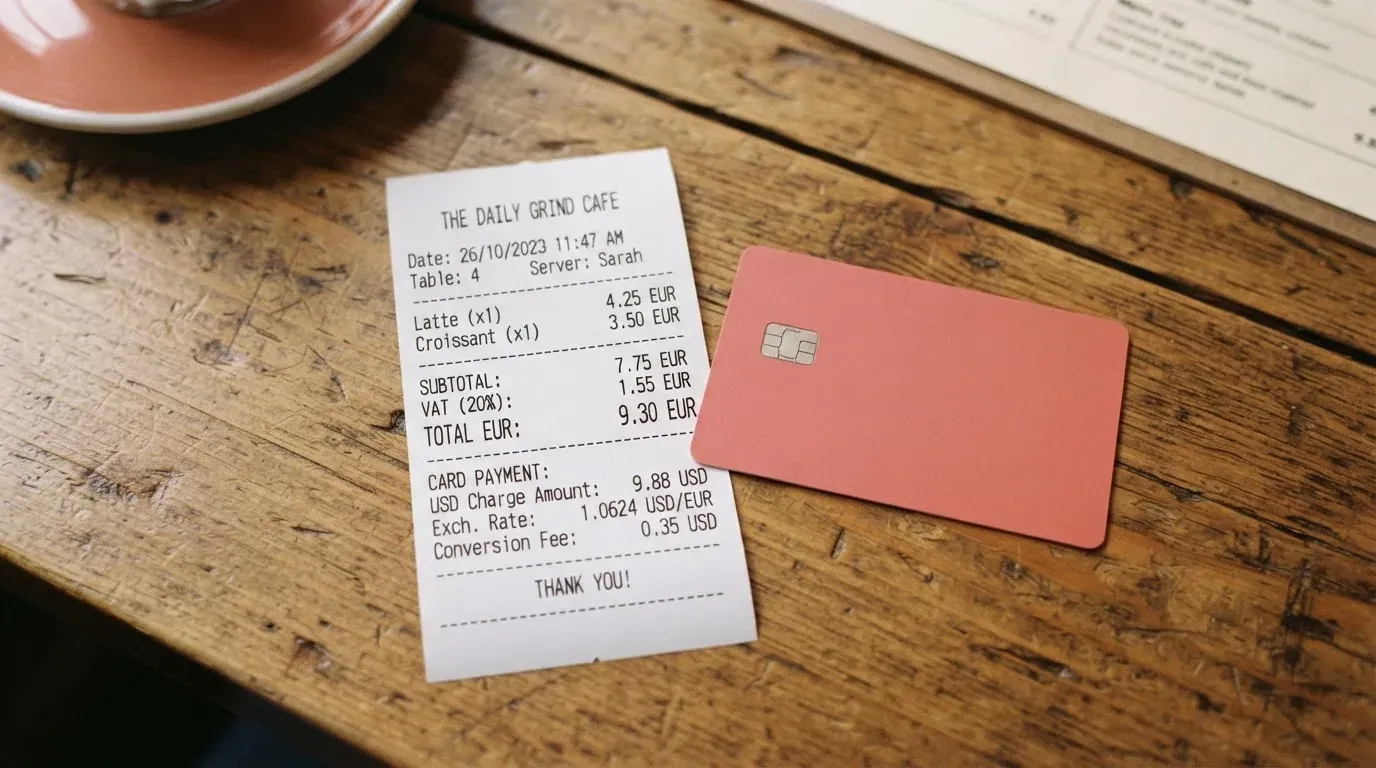
If you buy a coffee for EUR 4 in a shop in Paris, paying with the virtual Mastercard, the issuer side will run an authorisation in euros, no FX markup is published for eurozone transactions, and the EUR 2.99 you paid to issue the card is already in the past. The transaction is on a prepaid-style balance, so there is no overdraft risk and no interest. The cost is the EUR 2.99 you have already paid, plus whatever your crypto cost to top up the balance.
If you spend GBP 30 on a London transport card, your euro balance will be converted to pounds at the network’s wholesale rate, but the card-issuer FX fee for paying in a foreign currency is not stated. Some users in this category pay an extra 0.5% to 1.5% at this step; with Brighty you simply do not know from the public page.
If you withdraw EUR 200 from an ATM in Madrid, on a Visa card on the Plus plan, the unofficial fee is EUR 3.50 in the EEA. The ATM operator may also charge its own fee, and that is outside Brighty’s control. The Mastercard has no dependable ATM feature right now, per unofficial sources.
The honest summary: the cost of getting and running a Brighty card is small and well-disclosed. The cost of using it for FX, ATM withdrawals and foreign-currency spending is not fully published, and the unofficial numbers that exist for ATMs come from a third-party tracker that conflicts with the official limits on card spending, so they should be treated as a hint, not a quote.
How to top it up
You have two main routes into a Brighty account, and they are quite different in cost.
The first is sending crypto. Bitcoin, Ethereum and USDC are explicitly featured on the card page, and incoming crypto is free on every plan with no monthly limit. The supported outgoing networks are Ethereum, Tron, Bitcoin, Cardano, Tezos, Islamic Coin, TON, Arbitrum, Solana, Polygon and BEP20. Two things deserve attention here. First, networks matter: send USDC on a chain Brighty does not support and the deposit will either fail or land in a place the company has to recover manually, with no guarantee of getting it back. Second, the on-chain network fee is paid by you to the blockchain itself, not by Brighty, so on Ethereum mainnet a small top-up can be eaten by gas if you do not batch it well.
The second route is the IBAN. Brighty runs a euro-denominated account that takes SEPA, Faster Payments and SWIFT. Incoming SEPA costs 0.3% with a EUR 10 minimum, Faster Payments the same, and SWIFT 0.7% with a EUR 50 minimum. The monthly incoming fiat limit is EUR 100,000. If you are a UK freelancer being paid in pounds or a euro-area business receiving customer transfers, the IBAN is the more useful of the two routes and the cost is reasonable for occasional receipts, less so for small ones where the minimum dominates.
The card top-up fee and the minimum top-up amount are not stated, and the help-centre articles on deposit and refund were not read by me, so I cannot say whether there is a hidden percentage for moving money from your Brighty balance to your card. The simplest mental model is to treat the euro balance and the card as one pot, because the public materials describe it that way.
Paying with it every day
The everyday experience is uneven, and uneven in ways that matter.
On a virtual Mastercard, Google Pay works. Apple Pay does not, as of the company’s “Apple Pay & Google Pay” help article dated 26 May 2026, citing ongoing technical updates. On a Visa, Apple Pay does work. So the wallet you get depends on which network Brighty issues your card under, and that choice is not yours to make at the moment of issuance. If you live in a country where Google Pay is the dominant tap-to-pay wallet rather than Apple Pay, the Mastercard path is a better fit; if Apple Pay is your default, push for Visa.
The card page claims worldwide ATM acceptance, but the ATM fee is not published, and for the Mastercard the unofficial account is that there is no dependable current ATM feature at all. If cash matters, this is a real gap.
Spending crypto while it sits in your account is the headline pitch: “Keep earning on your crypto while using it.” The cashback rate, the eligible categories and the payout currency are not described in the official materials I read. Unofficial sources describe a 0.5% base cashback in USDC on every tier, with selected categories at 1.25% to 1.75% and monthly caps of 20, 60 or 100 USDC on One, Plus and Pro, paid the following month to a Reward Box. Those numbers are unofficial and not confirmed by the company, and the same source warns that cashback can be reversed if a purchase is refunded or charged back, so do not build a budget around them.
Blocked merchant categories are not listed on the page I read. For crypto cards in general, gambling (MCC 7995), crypto purchases, cash advances and some financial-services merchants are often restricted, but you should not assume that without seeing the actual list inside the app.
The app is rated 4.9 on the Turkish App Store storefront as of 20 October 2026, on the strength of nine ratings, which is a very small sample. The Google Play rating was not found in the materials I read. There is no published chargeback or dispute process, and the help-centre articles I saw were about wrong-network deposits and unsupported cryptocurrencies, not card disputes. The two are not the same problem: getting your money back when a merchant fails to deliver is a card-network process, and it is the part that is least clear here.
What can go wrong
The risks fall into three buckets: who holds the money, what the public record of complaints says, and what the regulatory setup actually is.
Who holds the money. Brighty describes itself as a financial technology company, not a bank. Accounts, cards, custody and the on-and-off ramp are run through “licensed partners” that are not named on the public pages. Unofficial coverage from September 2024 places Brighty in Switzerland and says the company holds crypto-exchange and digital-asset custodian licences, but the licences are not printed on the official site I read. When you fund the card, the euro sits with a partner, and the card is a prepaid product drawn against that balance. The funds are not bank deposits and are not covered by deposit guarantee schemes.
Custody. Brighty holds the keys. The official FAQ says user funds are kept in segregated accounts that are specially secured, both for fiat and crypto, and that the company works with penetration testers. No insurance is mentioned. Two-factor authentication is not mentioned on the FAQ I read. Card freeze and termination are in-app: freeze is reversible, termination is not.
The complaint record. Trustpilot shows 3.2 out of 5 from 78 reviews on the Belgian-Dutch page read on 20 October 2026. The recurring themes are account closures with no detailed explanation (the company cites policy and regulation when it does reply), referral bonuses that were not paid (the company cites suspected referral abuse), and “instant” transfers that took several hours. Some reviews praise the cashback. There are no card-specific complaints and no Reddit threads in the materials I read, which means either there are no card complaints, or they are buried in the general account complaints. Either way, the small sample size on Trustpilot means you should not over-read it.
Offboarding. Brighty’s published offboarding reasons include suspected fraud, unclear source of funds, partner-provider concerns, and PEP or sanctions status. That is a normal list, but combined with the closed-account complaints it tells you that this is a product where the company reserves the right to end the relationship if its partners flag something, and where you may not get a clear explanation.
What happens at programme-level. No Brighty programme has been publicly shut down the way FTX’s card was wound down after Visa terminated its global agreements in November 2022, or the way WaveCrest’s European programmes were closed in 2018. The relevant point is that the card-issuing partner, not Brighty, is the one that can lose its licence, and Brighty is not telling you who that partner is.
What to take instead
If Brighty does not fit, three alternatives are worth a look. Each one makes a different trade-off, so the right pick depends on what you actually need.
| Card | Score | Who it suits | Main trade-off |
|---|---|---|---|
| RedotPay | 6.9 / 10 | People who need both a USD and an HKD Visa, and a clear on-chain deposit flow | Hard-country rule: a long list of unsupported citizenships and a separate, longer list of unsupported residence countries for cards |
| Bitpanda | 6.5 / 10 | Euro-area residents who want a physical Visa and a regulated European broker behind it | One card at a time, euros only, and a Bankident-verified Bitpanda account cannot order one |
| Wirex | 6.7 / 10 | Users in 130-plus countries who want a metal Visa and WXT cryptoback | FX fee is not published as a number; it is shown in-app at the moment of conversion |
RedotPay. A virtual or physical Visa with USD and HKD card variants. Two separate lists decide who can use the app: a KYC list of unsupported citizenships, and a card-issuance list of unsupported residence countries. The lists overlap but are not identical; Russia, Belarus, Ukraine and Serbia are on both, and the card list adds India, Indonesia, Morocco, Nepal, Singapore and Turkey. Virtual card application is 10 USD, physical is 100 USD and non-refundable. The transaction fee is 1% (the crypto conversion), 1.20% for non-default currency, and 0.50 USD after the first three declined transactions per month. There is a 5 USD welcome reward that can only be spent, not used against the issuance fee. RedotPay Pro is a paid tier at 12.90 USD per month or 129 USD per year.
Bitpanda. A physical Visa debit card in euros, one at a time, with a free first shipment, a EUR 5.90 reissue and EUR 10 for each additional physical card. Non-euro spending has no Bitpanda FX fee, but Visa’s own cross-border markup applies. Spending is from a chosen main asset (crypto, precious metal, or euro) auto-converted to euros at the point of payment. The cashback rate is described as 1% in the body copy and “up to 2%” in the page summary, with the two not reconciled; fiat, stocks, metals and stablecoins do not earn it. Bankident-verified users cannot order the card.
Wirex. Available in 130-plus countries, with separate fee pages for the UK, EEA, APAC, Singapore, Australia and the rest. Card issuance is free in those regions, the metal Visa is 45 GBP in the UK with free DHL and 45 EUR delivery elsewhere, and there is a one-off 30 GBP administrative fee for accounts that break the general terms. FX is “market-leading” with no published percentage; the rate is shown in the app before you confirm. Cryptoback runs from 0.5% on Standard to 3% on Premium and up to 8% on Elite, paid in WXT, with a long list of ineligible merchant categories including gambling, crypto purchases, cash advances and the usual financial MCCs. In Singapore, cash withdrawals are not permitted.
Who I would recommend it to
Brighty is for someone in the EEA, or in Montenegro or Andorra and not a Russian national, who wants a single app that holds euros in an IBAN, holds a handful of crypto and stablecoin balances, converts between them at 0.4% to 0.6%, and spends the result through a virtual card. If that is your day-to-day, the published pricing is honest and the limits are generous enough for personal use.
Brighty is not for someone who needs a physical card in the next few months, because Mastercard physical orders are not being fulfilled and the physical Visa is not described as a current option either. It is not for someone who wants to see, in black and white, the name of the bank or e-money institution behind the card, because that information is not on the official pages. It is not for someone who plans to rely on chargebacks and disputes, because the dispute process is not described. And it is not for someone outside the supported countries, because the KYC step will fail before any of the other questions matter.
If you can live with those gaps, the product is a real one with real users. If you cannot, the alternatives above each address at least one of them.
Frequently asked questions
What is the Brighty card?
Brighty is a crypto account with an IBAN and a virtual Mastercard or Visa debit card, run by a financial technology company that says it partners with licensed institutions for custody, card issuance and on-and-off ramp services. The card is prepaid-style, so it spends from a balance you have already loaded.
How does the Brighty card work?
You sign up in the app, complete identity verification, then fund the account with crypto or by receiving SEPA, Faster Payments or SWIFT into the IBAN. You then spend the euro balance through the card. In-app currency conversion lets you move between euros, USDC, BTC, ETH and other supported assets at the published rate.
Is Brighty a bank?
No. Brighty describes itself as a financial technology company, not a bank. The bank or e-money institution behind the card and the IBAN is not named on the official pages. Funds are not deposit-guaranteed.
Who owns Brighty?
Brighty’s ownership is not on the public pages I read. Unofficial press coverage from September 2024 places the company in Switzerland, holding crypto-exchange and digital-asset custodian licences, but that is not confirmed on Brighty’s own site and should be treated as unofficial.
Is the Brighty card available in my country?
The card product page is labelled EEA only, and the app has been extended to Montenegro and Andorra. Russian nationals residing in Montenegro or Andorra are explicitly excluded. A full country list is not published; if you do not see your country in the app during sign-up, the answer is no.
How do I get a Brighty card?
Download the app, complete the Sumsub-powered identity check with a clear photo of your ID, your full personal details and a recent proof of address, and issue a virtual card for EUR 2.99. Physical cards are not being fulfilled at the moment, per unofficial sources.
Does Brighty require KYC?
Yes. KYC runs in-app at sign-up through Sumsub. The detailed verification levels and processing time are not described in the materials I read; the public rules cover which documents are accepted and which get rejected.
How do I top up my Brighty card?
Send crypto on one of the supported networks (Ethereum, Tron, Bitcoin, Cardano, Tezos, Islamic Coin, TON, Arbitrum, Solana, Polygon or BEP20) to your in-app deposit address, free on every plan. Or send euros via SEPA (0.3%, min EUR 10), Faster Payments (0.3%, min EUR 10) or SWIFT (0.7%, min EUR 50) to the IBAN, up to EUR 100,000 a month.
Can I add the Brighty card to Apple Pay or Google Pay?
On a Visa, Apple Pay works. On a Mastercard, Apple Pay is currently unavailable, per Brighty’s own help article dated 26 May 2026. Google Pay works on the Mastercard.
Is the Brighty card safe?
Brighty holds custody of your funds in segregated accounts, works with penetration testers and does not lend, which is the same shape as a regulated e-money setup. No insurance is mentioned, 2FA is not described on the public FAQ, and the card-issuing partner is not named. Treat it as you would any custodial crypto product: real, regulated in part, but not a bank.
App and neobank cards – cryptocardsranked
Content created by the «cryptocardsranked» team