
Tonhub card review: a non-custodial Visa Debit for TON and USDC, with a lot the public pages don't say
 Available in US

The Tonhub card is a Visa Debit that draws on the crypto sitting in your own wallet rather than a balance held by a card company. The brand is part of the wider Tonhub (also referred to as “Holders”) product, and the card launched in November 2024 with EU residents as the first audience. If you’ve ever had a bank account closed, been refused a card, or just want to spend TON and USDC without first cashing out to a bank, the pitch is simple: your keys, your crypto, and a virtual Visa you can use online and in stores.
This review walks through who the card is for, what the public pages say and what they don’t, what it actually costs, how the daily payments feel, and the alternatives worth comparing. I read the Tonhub public material, looked at the user feedback I could find, and put it side by side with three other crypto cards that solve a similar problem.
Conditions are current as of October 28, 2026.
Verdict
The Tonhub card sits in an unusual corner of the crypto-card market. It is non-custodial, which means the funds it spends stay in your own wallet until the moment of payment, and it leans hard on TON and USDC. That structure appeals to people who already hold self-custody wallets and don’t want to hand their seed phrase to a card company. It is also the reason I land on a middling score: the card does what it says, but the public pages leave a lot of basic questions unanswered, and the user feedback I could find is thin and not reassuring.
I’d give the Tonhub card 5.3 out of 10. It is a real, working Visa Debit with audited smart contracts, and it lets EU residents spend TON and USDC without a custodian in the middle. At the same time, almost no fees are published, the operator and the issuing bank are not named on the public page, the user feedback available is sparse, and the only Trustpilot review describes a slow dispute and money not yet returned. If you are an EU resident who already keeps a self-custody TON or USDC balance, it is worth a close look. If you want a published fee schedule, a tiered rewards system, or a card you can hand to a teenager, this is not it.
Score breakdown
| Criterion | Mark | Reason |
|---|---|---|
| Who can get it | 5 / 10 | Open to EU residents aged 18+; only a usage stat of “25+” countries is given, and the operator and card issuer are not named on the public page. |
| Cost | 7 / 10 | The public fee schedule is empty; one unofficial figure from late 2024 puts the per-transaction fee at 1.5%. |
| Top-up options | 5 / 10 | TON and USDC are shown on the page, USDT is mentioned by a user, and SEPA and SWIFT bank transfers are also offered. |
| Reliability and complaints | 4 / 10 | Operator and issuer not named; smart contracts audited by Trail of Bits; Trustpilot shows 3.2 from a single review, with a dispute unresolved after two months. |
| Everyday use | 5 / 10 | Virtual Visa Debit only after identity verification; unofficial sources say Apple Pay and Google Pay are supported; ATM terms are not published. |
| Total | 5.3 / 10 | A genuine self-custody card for a narrow EU audience, held back by missing fee details and sparse user feedback. |
Who can get the Tonhub card
The audience Tonhub targets is narrow on purpose. The public page says you need to be at least 18 and live in the European Union. Outside the EU the brand cites “25+” countries as a usage figure, which is a way of saying the card is used in many places but is not officially issued to people who live there. The page also has a separate regional note in its third-party coverage that initial issuance was for EU residents with an expansion planned in 2025, but I could not find confirmation of that expansion when I checked.
This matters if you are reading from outside the EU. You may be able to use a card you obtained while living in the EU, but you will not be able to apply and verify from, say, the UK, the US, or most of Asia. Citizenship is not described as a separate rule, but EU residence is required, so the actual screening policy isn’t visible to applicants. If you have a UK or US passport but live in Germany, you are still going through an EU-based identity check.
The card is also only a virtual Visa Debit, at least on the public page. There is no mention of a physical version, delivery time, or shipping cost, so if you want a piece of plastic to tap at a turnstile, the Tonhub card is not that product. The card’s currency is not stated, either, which makes it hard to plan a holiday spending budget before you go.
For most people, the simple way to think about it is: if you are an EU resident 18 or older, you can apply; if you are not, you cannot. There are no published tiers, no premium version, and no “teen” or “family” card.
How to sign up
Sign-up starts in the Tonhub app, where the card sits behind an identity verification step labelled “Verify Your identity.” The public page does not say which documents are required, what counts as proof of address, how long verification takes, or what causes a rejection. That silence is one of the bigger practical problems with this card: a person applying has no published checklist, so they have to start the process before they know what is being asked of them.
The flow, as far as it is described, is straightforward. You install the app, set up or import a self-custody wallet, tap the Tonhub Card banner, and complete identity verification. The virtual card is then issued. Once you have it, the card number and the usual card details are available inside the app, ready to add to a mobile wallet or use for online checkout. The page does not list the platforms the app is on, and the app store ratings were not read for this review.
Because the card is virtual-only, there is no delivery step. There is also no activation step that requires a separate code, since the card is already “live” once verification is complete. What is not described anywhere is what happens if verification fails, how to retry, or how long the queue is, and that is the kind of detail people usually want before they hand over an ID document.
A small but important note: identity verification is mandatory. There is no way to use a Tonhub card without going through it, and the verification is performed by the card programme’s compliance team, not by Tonhub’s brand layer alone. Anyone who needs a card that can be obtained without an ID check is in the wrong place.
Fees: what the Tonhub card really costs
The honest first sentence here is: the public page has a section called “Fees & Conditions” but no fee amounts are published. The card is described as free to issue, in line with most crypto cards, and an unofficial figure from late 2024 (cited by Forklog and a company profile on dealroom) puts the per-transaction fee at 1.5%. Until Tonhub publishes a number of its own, that 1.5% is the figure to plan around, and it should be treated as unofficial and not confirmed by the card.

The costs you can see, and the costs that aren’t stated, sit in this table.
| Fee or limit | Amount or status |
|---|---|
| Card issuance | not stated |
| Monthly or annual fee | not stated |
| Foreign-transaction (FX) fee | not stated |
| Crypto-to-fiat conversion fee | not stated; unofficial sources say 1.5% per transaction |
| ATM fee and ATM withdrawal limit | not stated |
| Daily spending limit | not stated as a fixed cap; user-set on-chain spending limits are mentioned |
| Monthly spending limit | not stated; user-set on-chain limits are mentioned |
| Top-up fee (SEPA / SWIFT) | not stated |
| Minimum top-up amount | not stated |
What that means in practice depends on what you do with the card. A few everyday examples help turn the silence into something you can budget against.
A €40 supermarket shop in Germany, paid with a USDC balance, would route through a euro cardholder transaction. If the unofficial 1.5% figure is right, the cost is about €0.60, and there is no foreign-transaction fee on top because the merchant and the card currency are the same. That is comparable to the cheapest custodial cards in the market.
A US$200 online subscription paid in dollars from a USDC balance, again at 1.5%, would cost about US$3.00. If the card currency turns out to be euros and your balance is in USDC, you also pay the network’s wholesale FX margin. Neither the conversion rate nor the FX margin is published, so the actual charge could land anywhere in a wide range.
A €500 SEPA top-up from a euro bank account has no card-side fee stated, but SEPA itself can be free or up to a few euros depending on your bank, and on-chain network fees (the “gas” charged by the blockchain) are paid by you, not by Tonhub, when crypto is moved into the wallet that funds the card.
The big gap is ATM use. There is no published ATM fee, no daily ATM cap, and no list of supported ATM networks. If you plan to take cash out, this is the section to read first and the figure to confirm with support before relying on the card.
Top up: how to fund the Tonhub card
The Tonhub card is non-custodial, which changes the way top-ups feel compared to a card you fund with a bank transfer. Your crypto stays in your own wallet until the moment of payment; Tonhub then pre-funds the purchase in fiat and debits your crypto balance after the network and the merchant confirm the transaction. If your balance is not enough, the payment is declined and nothing is taken. This is one of the more interesting design choices in the market, because the card never holds your money; it borrows against it for a few seconds and then settles.
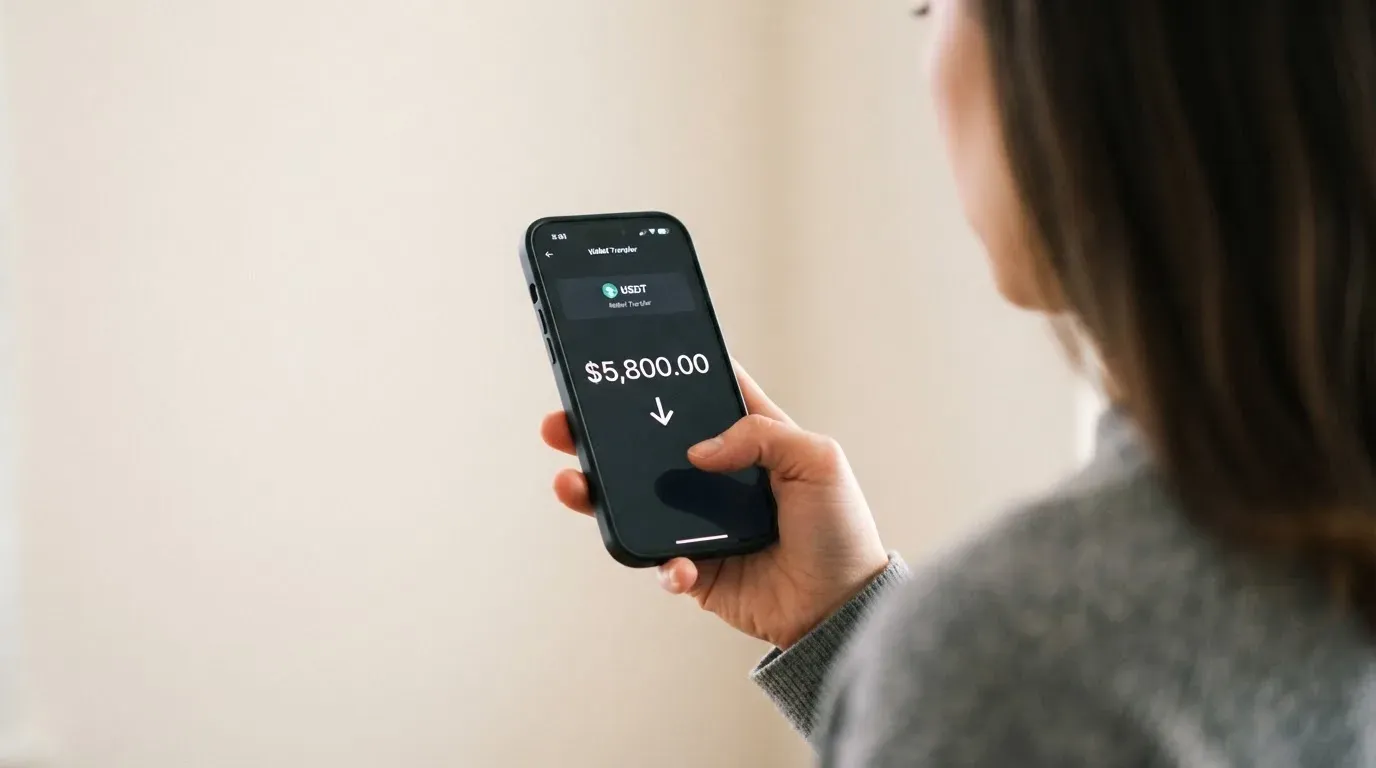
The supported coins shown on the public page are TON and USDC, and a user review quoted on the page also mentions paying with USDT. The card currency itself is not stated, which means you do not know whether a USDC balance is converted to euros or dollars at the point of sale, or whether the card holds a euro balance that the network converts on your behalf. That is a question worth asking before the first payment.
For people who would rather not move crypto at all, the page also describes SEPA and SWIFT bank transfers as a top-up route. The fees and minimums for those are not stated, so a euro bank transfer from Germany will probably be cheap or free at the bank end, but the SEPA fee on the Tonhub side, if any, is unknown. SWIFT transfers almost always carry a bank-side fee, and the card-side fee (if any) is also unknown.
In practical terms, the cheapest way to fund a Tonhub card is to keep TON or USDC in the connected self-custody wallet and let the card pre-fund the payment. The cost is the on-chain network fee for the debit, plus whatever conversion margin the card charges (1.5% per the unofficial figure), and nothing more. Anything that involves a bank transfer adds a step and a fee that is not currently published.
There is also a feature called “Emergency Withdrawal” that lets a designated heir retrieve card-linked funds on-chain, which is unusual in this market and worth knowing about if you are setting up a long-term self-custody arrangement.
Paying with the Tonhub card every day
Once the card is issued, it behaves like a normal virtual Visa Debit. You can type the number into a checkout form, save it to a subscription, or add it to a mobile wallet. The page does not list which mobile wallets are supported, but a user review quoted on the page mentions Apple Pay, and an unofficial late-2024 source says Apple Pay and Google Pay are both supported. That is consistent with most virtual Visa programmes, but again it is unofficial and not confirmed by the card.
A few practical things to know about daily use.
- The card is virtual only. There is no plastic to hand over at a restaurant, which is fine for online checkout and tap-to-pay on a phone, less fine for an old-fashioned restaurant that wants to swipe.
- Refunds are described as limited to “legitimate, verified transactions,” and the card is set up so failed or declined authorisations do not deduct anything from your balance. The dispute time frames and chargeback policy are not stated, so it is hard to know how long a refund dispute can take or what evidence is needed.
- An authorisation hold can stay on your balance for several days (typically up to seven) even if the payment later fails, because the hold comes from the merchant side, not the card. This is standard across the network and not unique to Tonhub.
- The card can be used anywhere Visa is accepted online, and at any point-of-sale terminal that takes a tokenised Visa from a mobile wallet. There is no published list of blocked merchant categories, so gambling, adult content, and similar categories are not stated to be blocked or allowed.
- You can set your own on-chain spending limits, which means you can cap how much the card is allowed to spend in a day even if your wallet balance is higher. This is a useful safety feature if the card details leak.
There is no rewards or cashback section described on the page, so the everyday value of the card is the convenience of paying from a self-custody balance, not a points scheme.
What can go wrong
The risk profile of the Tonhub card splits into two parts: the smart-contract and custody side, and the customer-service side.
On the smart-contract side, the card’s contracts have been audited by Trail of Bits, a well-regarded security firm, and the brand leans on that fact publicly. Funds stay in the user’s own wallet, and Ledger hardware wallets are supported, which means the user keeps control of the private keys. Every transaction is monitored for fraud and anti-money-laundering, and suspicious activity is blocked automatically. None of that removes risk: a user can still be phished, lose a seed phrase, or have clipboard malware swap a copied address, and the irreversibility of crypto transfers means a typo can be permanent.
On the customer-service side, the picture is thinner. Trustpilot shows 3.2 out of 5 from a single review, and that review, dated 18 February 2026, is worth reading closely. The user reports that it took two months to file card chargeback disputes for transactions filed in early December 2025 and won in January 2026, with the money not yet returned by mid-February 2026. The same user describes slow, copy-paste support answers and extra AML video-call identity checks even though they had already been verified. This is one review, and it is not a pattern, but it is the only Trustpilot review, and the public support channels the page links to are a generic help center (help.holders.io) with no published service-level targets.
There are also structural risks the page does not address. Naming the operator and issuer would make it easier to check licences and complaints, but they are not listed. The page is also silent on what happens to a user’s wallet or card balance if the programme is closed: a closure typically stops new spending first and gives users a window to withdraw balances, but the exact process and timing are not stated. No 2026 news about closures or expansions was found for this review.
Finally, like any self-custody arrangement, a stolen or lost seed phrase is unrecoverable. The “Emergency Withdrawal” feature for heirs is a partial mitigation, but it depends on the user setting it up and naming the heir in advance, and the user is still the single point of failure.
What to take instead
If the Tonhub card does not quite fit, three other crypto cards solve similar problems, and they are worth comparing side by side.
MetaMask Card (7.1 / 10). The MetaMask Card is a Mastercard that spends directly from the connected wallet, and it works in 45 listed countries and territories with proof of residency. US and UK sign-ups are temporarily closed per the FAQ, which is worth checking if that affects you. There is a free Virtual card issued instantly and a Metal card at US$199 a year. Cashback is paid in mUSD (MetaMask’s stablecoin) into the Money Account: 1% on the Virtual card, 3% on Metal up to US$10,000 of spend and 1% after that. Networks are Linea, Base, Monad and Solana, and named tokens include mUSD, wETH, EURe, GBPe, USDC and USDT, with the page saying nine in total. MetaMask also runs a $FLY bonus multiplier through the Blackbird dining app. The fees are described as “minimal” with no MetaMask-side FX fee and the Mastercard wholesale rate used for conversion, although the exact figure is not on the public pages.
KAST (6.1 / 10). KAST is a Visa programme with up to ten cards per user, three tiers (Standard, Premium at US$1,000 a year, Private at US$10,000 a year) and several designs including Visa Platinum, Visa Infinite metal, and Visa Infinite gold plated. Standard has no annual fee, the physical Standard card has no card fee but a US$40 delivery charge, and Premium and Private include a physical card. Fees are unusually low: stablecoin top-ups at 0%, card spend in USD at 0%, no transaction fee, and a non-USD FX fee of 0.5% to 1.75% depending on residency, transaction country, and card programme. Small non-USD transactions under US$25 cost US$0.10, and a declined transaction for insufficient balance costs US$0.50. Cashback is paid in USD: 1.5% on Standard up to US$2,000 a month, 2% on Premium up to US$10,000 a month, 3% on Private up to US$40,000 a month, plus KAST Points on the two paid tiers. The catch is that country availability is shown only at KYC: the page says “If your country isn’t listed, it means KAST is not available there,” and a restricted list is referenced but not named. Citizenship and ID matter as well; living in a supported country with an unsupported ID may still block KYC.
Zeal (6.1 / 10). Zeal is the consumer front of Gnosis Pay, and it is a Visa card with a virtual card for online use, addable to Apple Pay, with accounts in EUR, USD and GBP. Spend is accepted in 150+ countries, and the card programme is live in the EU, UK, Brazil, Colombia, Mexico, Japan, Singapore, Philippines, Indonesia, and Thailand. The fee schedule is not published, but Zeal charges no additional FX fee and converts at the Visa wholesale rate, and Gnosis Pay fees (for example on ATM use) may still apply. Cashback is paid in GNO on Gnosis Chain at up to 4%, and the App Store also advertises up to 5% variable APY on EUR and USD balances. A physical card is not stated for Zeal.
If you want published fees and tiers, KAST is the most explicit. If you want a card that is widely available in the EU, the UK, the Americas and parts of Asia, MetaMask Card has the broadest country list. If you want multi-currency accounts (EUR, USD, GBP) and Apple Pay support on a Visa, Zeal is worth a close read. The Tonhub card’s selling point is non-custody: the others are custodial or partly custodial, and that difference matters if you do not want to hand your seed phrase to anyone.
Who I’d recommend the Tonhub card to
The short list of people who should seriously consider the Tonhub card is narrow. You should look at it if you are an EU resident aged 18 or older, you already keep a self-custody TON or USDC balance, you want to spend that balance without first moving it to a custodian, and you are comfortable with a virtual card and the published-fee gaps. You should also be the kind of person who reads the Tonhub smart-contract audit on their own and sets an on-chain spending limit before the first payment.
You should look elsewhere if any of the following apply. You live outside the EU. You want a physical card. You want a published fee schedule. You want cashback, points, or a tiered rewards system. You want an ATM card with a clear withdrawal fee. You want a programme whose operator and issuing bank are both named on the public page. You want an easy refund experience with published dispute time frames.
For the people who fit the first list, the Tonhub card is a real and useful product. The “Verify Your identity” gate, the self-custody model, the non-custodial pre-funding at the moment of purchase, and the Trail of Bits audit add up to a credible design. For the people who fit the second list, the same product is a research project.
If you do apply, the practical steps are: set up the Tonhub app, set up or import a self-custody wallet, tap the Tonhub Card banner, complete identity verification, set a conservative on-chain spending limit, fund the wallet with TON or USDC (or top up via SEPA), and treat the first few payments as tests. Hold off on anything time-sensitive, like a hotel deposit or a flight, until you have seen a refund and a declined transaction go through cleanly.
Frequently asked questions
What is the Tonhub card?
The Tonhub card is a virtual Visa Debit that lets you spend from a crypto balance kept in your own self-custody wallet. The brand is part of Tonhub, also referred to as “Holders,” and the card launched in November 2024 with EU residents as the first audience.
How does the Tonhub card work?
At the moment of payment, Tonhub pre-funds the purchase in fiat and then debits your crypto balance after the network and the merchant confirm. If your balance is too low, the payment is declined and nothing is taken, so the card cannot overdraw your wallet.
Is Tonhub a bank?
Tonhub is not a bank. It is a crypto-wallet product that partners with a card-issuing programme to provide a Visa Debit. The licence behind the card is not visible to applicants.
Is the Tonhub card available in the United States?
The public page says the card requires EU residence and the “25+” countries figure is given as a usage statistic rather than a list of supported residence countries. People in the US, the UK, and most of Asia are not stated to be eligible to apply.
How do I get the Tonhub card?
Install the Tonhub app, set up or import a self-custody wallet, tap the Tonhub Card banner, and complete identity verification. The virtual card is then issued inside the app. Documents, processing time, and rejection reasons are not stated.
Does the Tonhub card require KYC?
Yes. Identity verification is mandatory before the card is issued, and the public page labels the step “Verify Your identity.” What documents are accepted, what counts as proof of address, and how long verification takes are not stated.
How do I add the Tonhub card to Apple Wallet?
A user review quoted on the page says the card can be added to Apple Pay, and an unofficial late-2024 source also lists Google Pay. The card is virtual only, so you add it to your mobile wallet the same way you would add any other virtual Visa: open the wallet app, choose to add a card, and either type the details or scan them from the Tonhub app.
How do I top up the Tonhub card?
The card spends from a connected self-custody wallet, so topping up means putting TON or USDC (and, per a user review, USDT) into that wallet. The page also describes SEPA and SWIFT bank transfers as a top-up route, and the on-chain network fee for the debit is paid by the user, not by Tonhub.
Is the Tonhub card safe?
The smart contracts have been audited by Trail of Bits, the user keeps control of the private keys, and Ledger hardware wallets are supported. The card is non-custodial, so funds stay in your own wallet until the moment of payment, but the user is responsible for keeping the seed phrase safe and for any on-chain transfer mistakes.
Is the Tonhub card worth it?
If you are an EU resident with a self-custody TON or USDC balance and you want to spend directly from that balance, the Tonhub card does what it says and is worth a close look. If you want a published fee schedule, a tiered rewards scheme, or a physical card, the same product is harder to recommend and one of the alternatives above is likely a better fit.
Wallet cards – cryptocardsranked
Content created by the «cryptocardsranked» team