
Zebec Card Review: A No-Fee Prepaid Card for Spending Crypto, With Several Loose Ends
 Available in US
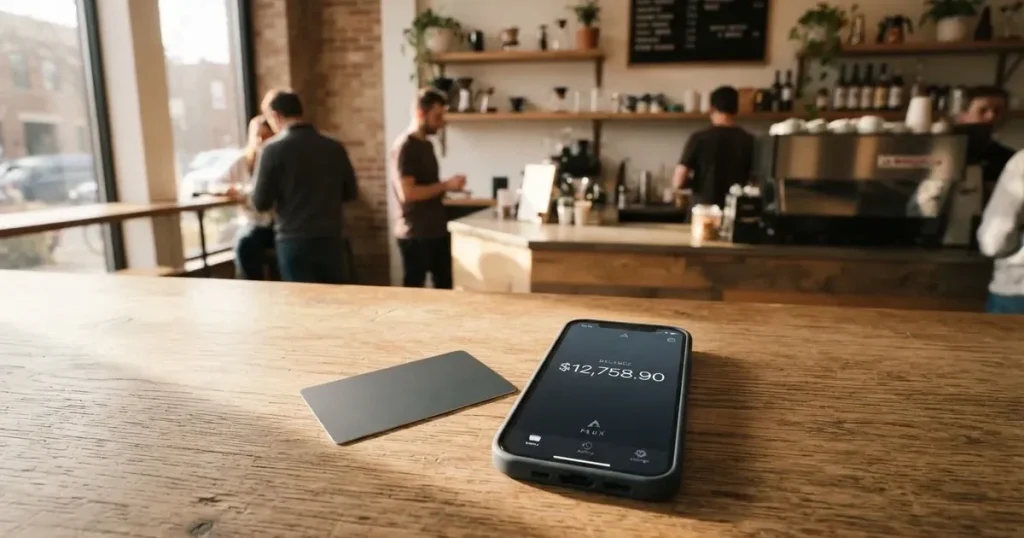
The Zebec card is a prepaid Mastercard you load with crypto and spend like an ordinary payment card. On paper the cheapest tier is genuinely free: no sign-up fee, no transaction fee, Apple Pay and Google Pay on every level. What stops it scoring higher is not the pricing but the gaps — the card issuer is not named, the Black tier was offline for upgrades, the company’s own pages contradict each other on how many countries Carbon covers, and no cardholder reviews exist anywhere, good or bad. My score is 7.1 out of 10. It suits you if you are already inside the Zebec wallet, hold or plan to hold the $ZBCN token, and want a simple prepaid card without monthly charges. It suits you less if you want cash at an ATM, a physical card in the post, or a company that will tell you plainly who stands behind the balance.
The conditions described here are current as of October 28, 2026.
Verdict: 7.1 out of 10
The single strongest thing about Zebec is the price of the entry tier. Silver carries no sign-up fee and no transaction fee, and Carbon does too while a promotional no-fee arrangement lasts — though Zebec’s own documentation calls that arrangement a promotion that can change. Above that, Black is priced in the opposite direction: activation, top-up and monthly fees apply, with only the top-up amount given as approximately 2% and the activation and monthly amounts small fixed figures. So this is not a card where the free tier quietly grows into a paid one — it is a ladder with a free rung and a deliberately premium top rung.
Here is how I broke the score down, criterion by criterion, with the reasons I used.
| Criterion | Score | Why |
|---|---|---|
| Who can get it | 8 / 10 | Silver covers the US, Canada, the UK and EU states except Malta; Carbon USD International reaches 90+ countries outside the US and Canada; Black is aimed at the world subject to sanctions |
| Cost | 8 / 10 | Silver and Carbon have no sign-up and no transaction fee; variable FX fees may apply; Black charges for activation, top-up and the month |
| Top-up options | 9 / 10 | Funding runs from the Zebec wallet with 180+ tokens across 21+ blockchains, though specific coins are not named |
| Reliability and complaints | 5 / 10 | Issuer and BIN sponsor unnamed, legal entity undisclosed, no complaints or reviews found, and the Black page showed “offline for upgrades” |
| Everyday use | 5 / 10 | All tiers are Mastercard prepaid with Apple Pay and Google Pay, but physical form and ATM access are not disclosed |
Total: 7.1 / 10.
A word on who this is for, in my own framing. The user who gets the most out of this card is the one already funding a card from the 180+ tokens the wallet supports — that breadth of funding is the product’s real advantage, and it is why the top-up score is the highest in the table. If you hold one or two main stablecoins and want a predictable way to pay, the token variety is decoration. If you are moving across many chains and want any of them to be spendable, it is the reason to look here.
Who I would steer away: anyone whose plan involves an ATM, because Zebec’s public pages say nothing about cash withdrawal fees or limits. Anyone who needs a chargeback or a dispute process, because none is described on the cards, Black or payees pages. And anyone who wants to know which institution holds their money, because Zebec does not say — I will come back to that in the risks section, and it is the reason the reliability score sits at 5.
Will they give you the card?
Eligibility is decided by country of residence — Zebec calls this the “issue location”, defined as the country where you declare your home address and apply. Citizenship is not mentioned anywhere. That distinction matters more than it sounds, and I will explain it below.
The regional breakdown runs like this:
- Silver USD: the United States, Canada, Puerto Rico, US Virgin Islands, Guam, American Samoa and the Northern Mariana Islands.
- Silver and Carbon GBP: the United Kingdom, Gibraltar, Guernsey, the Isle of Man and Jersey.
- Silver and Carbon EUR: EU member states except Malta.
- Carbon USD International: 90+ approved countries outside the US and Canada, with Japan, Singapore, Brazil, Kenya and Uruguay given as examples.
- Black: global, subject to sanctions.
The currency you get follows your region: USD, EUR or GBP by programme, with Black on USD in the documentation. Zebec’s Silver blog notes the practical upside of matching currency to region — if your card is denominated in the same currency as the money funding it, you avoid FX fees entirely, though the size of that fee is never stated.
Then there is the list of places where the cards “cannot be used”. It includes the Russian Federation and Belarus, and also Iran, Cuba, Syria and North Korea. The restriction, as Zebec presents it, is on the location of use, not on where you signed up. If you are in a supported country and travel to a restricted one, that is a different problem from being refused at application.
One internal contradiction to know about before you apply: the Carbon page says USD International is offered in “over 70 countries” while the availability page says “90+”. Both are official Zebec pages. Zebec does not reconcile them, so treat the lower figure as the safer assumption if you are in a country near the boundary of the list.
On citizenship more generally — this is the part where card rules routinely diverge from address rules. Nationality is recorded and screened separately from residence because sanctions screening and issuer risk policy are applied to citizenship and country of birth as well as to the country of address. Zebec says nothing about citizenship for its own cards, but the institutions behind them will have their own policies. I am not going to tell you how to structure anything around that; I am telling you it is a separate question from your address, and the honest answer from Zebec’s public pages is not stated.
How to get it
You order the card inside the Zebec Mobile SuperApp on iOS or Android, or the Web SuperApp, and you fund it from the Zebec wallet. There are three tiers, all Mastercard prepaid:
- Silver — single-use. Each issuance gives you a new card number. USD, EUR or GBP depending on region. Load $10–$1,000, maximum balance $1,000, no sign-up fee, no transaction fee.
- Carbon — reloadable, and the card number stays the same across top-ups. USD, EUR or GBP. Load limit $1,000 / £1,000 / €1,000 per the cards page, with the Carbon page saying $10,000 USD per load; maximum balance $10,000 / £5,000 / €5,000.
- Black — premium reloadable, USD, aimed at high spenders, enterprises and invited users. Up to $10,000 per load, maximum balance $50,000.
On the identity checks: what documents you need, what proof of address is required, and what age is enforced are all not stated on the public pages. What Zebec does describe is the mechanism. Zebec and its card partners check your device IP address and the address you have declared, and that is how the regional restrictions are enforced. Silver needs a local phone number in your region, with one-time codes sent by SMS. Carbon USD International uses email tokens instead. The Black tier’s page says KYC information must be submitted before activation.
The KYC depth also differs by tier and is described loosely. Silver’s blog describes a limited KYC based on address, with activation in seconds after email confirmation. Black requires KYC information to be submitted. Tiers of KYC levels, the reasons a verification can be rejected, and any official processing time for Silver or Carbon are not stated — so treat “seconds” as a marketing description rather than a commitment.
Delivery is the biggest practical unknown. Whether you receive a physical card, when it would arrive, and whether there is a separate virtual form are not stated. What the documentation describes is digital activation only, and the Black page claims activation in under a minute after KYC, citing 30 seconds. For your planning: assume you are getting a card number you add to a phone wallet, not a piece of plastic in the post.
One unofficial note, so you know its weight: a third-party directory, CryptoCardHub, undated, describes Zebec cards as virtual with physical cards planned and not widely distributed. That is not Zebec’s own statement, and I could not confirm it against the card’s public pages.
What it really costs: Fees
The headline is accurate — Silver has no sign-up fee and no transaction fee, and Carbon has no sign-up fee and no transaction fee while its no-fee promotion runs, which the documentation flags as subject to change. What catches people out is everything the headline does not cover, and Zebec’s own pages are clearer about what is missing than about what it is.
Here is every fee and limit figure Zebec publishes, gathered in one place:
| Fee or limit | What Zebec states |
|---|---|
| Silver sign-up fee | None |
| Silver transaction fee | None |
| Carbon sign-up fee | None, described in the documentation as a no-fee promo subject to change |
| Carbon transaction fee | None, on the same promotional basis |
| Foreign exchange | “Variable FX fees may apply”; exact percentages not stated |
| Crypto conversion | Rates vary by token; exact percentages not stated |
| Black activation fee | $1 |
| Black top-up fee | Approximately 2%, plus $0.30 per transaction |
| Black monthly fee | $1 |
| Black gas, conversion and exchange fees | Variable and additional |
| Silver top-up fee | Amount not stated |
| Carbon top-up fee | Amount not stated |
| ATM fees | Not stated |
| Silver load | $10–$1,000 |
| Silver maximum balance | $1,000 |
| Carbon load | Minimum $10; $1,000 / £1,000 / €1,000 per the cards page, $10,000 USD per load per the Carbon page |
| Carbon maximum balance | $10,000 / £5,000 / €5,000 |
| Carbon daily spend | $10,000 (USD) |
| Black load | Up to $10,000 |
| Black maximum balance | $50,000 |
Now three everyday payments, walked through, so you can see which fees actually attach.
Paying for coffee in the currency of your card. This is the clean case. On Silver, you loaded from the Zebec wallet, you pay in dollars at a dollar shop, no sign-up fee, no transaction fee, no conversion because no conversion happened. Nothing is charged beyond the network cost of your original deposit.
Paying in a currency your card does not hold. Silver in dollars, coffee in euros. Here the FX fee applies, and “variable” is all Zebec says. This is the specific number I would want before committing, and I could not find it published. The Silver blog’s advice is the practical mitigation: match your card’s denomination to the currency you are spending in, and you sidestep the fee. Choosing USD for the US, GBP for the UK, EUR for the euro area is not a preference — it is the cheapest configuration available.
Paying after topping up Black with crypto. Here the fees stack visibly. On top-up, approximately 2% plus $0.30 per transaction; on the crypto side, gas, crypto conversion and exchange fees are variable and additional; then any FX fee if you spend in another currency; then $1 activation and $1 a month. Black is the tier where the fee schedule is a real line item rather than an absence, and it is worth comparing against the reward rates on other cards before choosing it.
The costs table has a conspicuous hole in it: ATM fees are not stated. Not “high”, not “none” — unstated. If cash is part of how you spend, that is a question to put to support directly rather than a gap I can fill.
How to top it up
Top-up runs from the Zebec wallet, and that is the mechanism: you do not connect a bank account, you move crypto already in the wallet into the card’s balance. Zebec describes “180+ tokens across 21+ blockchains” — the highest top-up score I gave, because the breadth is real — but it does not name the specific coins. So the breadth is real and the list is not published, which means you cannot confirm from the card’s pages whether your token is among them.
The minimum load is $10, on Carbon. Beyond that the tiers differ sharply: Silver tops up $10–$1,000 and caps the balance at $1,000; Carbon caps at $10,000 / £5,000 / €5,000 with daily spend of $10,000 in USD; Black reaches $50,000. The Silver ceiling is the one to watch. If you are loading more than a thousand dollars, Silver is the wrong tier by design.
On fees at the top-up step: Silver and Carbon top-up fee amounts are not stated, with only “variable FX fees may apply” and the note that crypto conversion rates vary by token. Black’s is stated, at approximately 2% plus $0.30 per transaction. Fiat top-up is not stated at all, consistent with funding being from crypto in the wallet.
Before you send anything, one technical point that costs real money when missed: blockchain transfers are irreversible. A deposit sent on a network the card provider does not support, or to an address belonging to a different network, can be lost or need manual recovery through support, with no guarantee. Sending USDT on Tron or USDC on Ethereum are not interchangeable instructions. Check the network the card expects for your token before you confirm, because there is no undo.
Withdrawing is not stated — no withdrawal fees, no process, nothing on the public pages.
Paying with it every day
Every tier is a Mastercard prepaid, and every tier works with Apple Pay and Google Pay. That is the everyday-use story in one line, and it is genuinely the good part: the wallet connection and card are separated, with Zebec describing a non-custodial connection between the wallet and the app, so your crypto keys are not handed to the card programme.
Rewards are where the reading gets more ambiguous. No cashback is stated. What is stated is that staking $ZBCN earns “extra rewards” — with the rate not stated. So the incentive here is a token-level one rather than a spend-level one, which means its value depends on what $ZBCN does, and I would not build a spending decision on it.
Which merchants accept it: blocked merchant categories are not stated. That matters in practice, because gambling (MCC 7995) and similar categories are blocked by many issuers as policy rather than by law, and the blocked list varies by issuer. Since Zebec does not publish one, you are guessing.
The app itself: Zebec Mobile SuperApp on iOS and Android plus a Web SuperApp. The Apple App Store listing shows 5.0/5 from 2 ratings, English, read 2026-10-20 — two ratings is not a signal about anything, and I would not treat it as one. The Google Play rating is not stated.
If a payment goes wrong, the safety net is thin in a specific way. No dispute, refund or chargeback process is described on the cards, Black or payees pages. The only route described is contacting support. For prepaid cards, chargeback coverage varies and should not be assumed. I would not tell you this card is unsafe — I am telling you that if a shop takes your money and does not deliver, the process you would rely on is the one Zebec’s own pages do not document.
What can go wrong
The reliability score of 5 is not about complaints, because there are none to count. It is about disclosure.
Nobody is named. The card issuer and BIN sponsor are not stated, and neither is the legal entity behind Zebec. Mastercard appears only as a partner logo. This is not a criticism unique to Zebec — plenty of crypto card brands are programme managers in front of someone else’s licence — but for you it means a question you would want answered cannot be: if the card balance were somehow at risk, which institution is answerable, and under which licence? I went looking and the answer is not stated on the public pages.
The track record is thin on both sides. No official incidents are stated, and no user reports were found. There is no Trustpilot page for Zebec cards and no Reddit threads about them. A third-party directory, CryptoCardHub, rates the Zebec Card 3.3, ranked #23 of 86. Absence of complaints with almost no users is not a good signal — it is a small sample. Treat the 5 as “not enough is known”, not “something went wrong”.
The Black tier was offline. The Black page showed the site “temporarily offline for upgrades” with resumption expected in Spring 2026. The UK was listed as restricted pending regulatory review, in the page’s own wording. What happened after that date is not confirmed. If you were considering Black for its $50,000 ceiling, check the page yourself before planning around it.
The company’s own pages disagree. “Over 70 countries” on the Carbon page, “90+” on the availability page. Minor on its own; a reminder that the details worth checking are not always the ones that are consistent.
The history is a relaunch. Silver is a relaunch of the earlier Zebec Instant Card, per a blog whose date is not shown. Carbon launched with Mastercard on March 27. I found no 2026 issuer change. What a relaunch means practically is that documentation can lag behaviour, which is the practical reason to verify anything critical with support rather than assume.
Balances are not described as yours. Zebec says the wallet is separate from the app via a non-custodial connection, and that the card balance is held with the card programme — but the custody arrangements for card funds are not stated. So your crypto keys may never leave your control while the spendable balance sits with an unnamed programme holder. Those are two different risk profiles and only one of them is clear.
Where you cannot use it. The compliance list covers the Russian Federation, Belarus, Iran, Cuba, Syria and North Korea, and the restriction is on where you use the card. Also worth knowing generally: stablecoins are not censorship-proof — Tether says it disables tokens in wallets on the OFAC sanctions list and has frozen funds tied to illicit activity.
What this category has done before. There is history here, and it is not reassuring. Visa terminated its global agreements with FTX on 13 November 2022 and the FTX US debit card was wound down. WaveCrest, a Visa issuer that supplied crypto card brands, was suspended by Visa in Europe in 2018, closing all WaveCrest-issued Visa programmes. Programme closures follow a pattern: notice, then spending and loading stop, then users are asked to withdraw remaining balances. One 2026 closure reported by a secondary source had new loads ending 8 July 2026 and spending stopping 8 August 2026 — that is a single unconfirmed source, but it shows the shape.
That last point is why the unnamed issuer bothers me more than the missing reviews. In a closure, the practical questions are who sends the notice, how long you get, and how balances are returned. None of that is described here. On safety specifically: Silver and Carbon USD Regional use 2FA tokens by SMS, Carbon USD International uses email, Black can be frozen immediately in the Mobilum app with Mobilum as the backend processing partner, and spending controls and insurance are not stated. I would rather you hear those limits from me than assume a frozen card and a phishing-resistant login are both in place.
What to take instead
Three alternatives came up repeatedly in the same category. Here is how they compare on the points that decide this choice, with their scores as I have them.
| Zebec | MetaMask | KAST | Zeal | |
|---|---|---|---|---|
| Score | 7.1 / 10 | 7.1 / 10 | 6.1 / 10 | 6.1 / 10 |
| Card | Mastercard prepaid, three tiers | Mastercard, virtual first, Metal pre-orderable | Visa Platinum, Infinite metal, Infinite gold, plus themed designs | Visa, virtual, addable to Apple Pay |
| Sign-up reach | Silver US/Canada/UK/EU except Malta; Carbon 90+ outside US/Canada; Black global subject to sanctions | 45 listed countries/territories; other regions on a waitlist; US/UK sign-ups temporarily closed | Residence list shown at KYC but not published; a supported residence plus a restricted-region ID can still fail KYC | Spend in 150+ countries; issuance depends on eligibility and regional availability |
| Cost | Silver and Carbon no sign-up or transaction fee; Black $1 activation, ~2% plus $0.30 top-up, $1 monthly | Virtual free, no annual or maintenance fee; Metal $199/year | Standard $0, Premium $1,000/year, Private $10,000/year, billed annually upfront | Not stated — no fee schedule published |
| Fees | Variable FX fees may apply; conversion rates vary by token | “Minimal fee for each transaction”, amount not stated on the pages read; no additional MetaMask fees; no foreign transaction fee, Mastercard rate used | Stablecoin top-up 0%, USD spend 0%, transaction 0%, Apple/Google Pay 0%, non-USD FX 0.5%–1.75%, non-USD under 25 USD 0.10 USD, declined transaction 0.50 USD | No additional FX fee; conversion at Visa wholesale rate; Gnosis Pay fees such as ATM may still apply |
| Rewards | No cashback stated; staking $ZBCN earns extra rewards, rate not stated | Cashback in mUSD: Virtual 1%, Metal headline 3% but limited to the first $10,000 spent then 1%; $FLY bonus 5X/7X via Blackbird | USD cashback: Standard 1.5% on first $2,000/month, Premium 2% on first $10,000/month, Private 3% on first $40,000/month | Up to 4% cashback in GNO on Gnosis Chain, requiring GNO held in the card Safe; rates can change |
| Funding | Zebec wallet, 180+ tokens across 21+ blockchains, specific coins not named | Connected wallet on Linea, Base, Monad, Solana; mUSD, wETH, EURe, GBPe, USDC, USDT | USDT, USDC, PYUSD, RLUSD; no bank account needed | Balances in the card Safe, EUR/USD/GBP, Gnosis Chain and Celo per docs |
Three comparisons worth making out loud.
Against MetaMask. Same score, opposite shape. MetaMask is transparent about being a programme manager — issuer Monovate, card provider Crypto Life, virtual card instant, Metal pre-orderable — and it names its networks and its cashback rate. Zebec is broader in what you can fund it with (180+ tokens against nine named) and vaguer on everything structural. If transparency on the issuer is your priority, MetaMask is the more legible card. Note its own limits: US and UK sign-ups are temporarily closed per its FAQ, and the Metal tier costs $199 a year.
Against KAST. The most transparent pricing in the group — it publishes a fee schedule with actual numbers, including 0% top-up, 0% USD spend, 0% transaction fee, and a non-USD FX band of 0.5%–1.75%. Against that, its membership structure is aggressive (Premium $1,000/year, Private $10,000/year) and its country list is not published, which is its own kind of opacity. Also note a documented conflict: the app lists PYUSD and RLUSD while the Terms say acceptable tokens are “currently USDT and USDC”.
Against Zeal. Zeal has the simplest cost story of all — no additional FX fee, conversion at the Visa wholesale rate — and it will spend in 150+ countries. What it does not publish is a fee schedule at all, and its card programme is live only in a specific set of territories: EU, UK, Brazil, Colombia, Mexico, Japan, Singapore, the Philippines, Indonesia and Thailand, with update notes also mentioning Bolivia.
Whichever you look at, the same three checks apply: who the issuer is, what the FX fee actually is, and what happens to your balance if the programme closes.
Who I would recommend it to
I would recommend the Zebec card to someone who is already inside the Zebec ecosystem and holds $ZBCN, who wants a free Mastercard prepaid they can add to Apple Pay or Google Pay today, and whose spending stays close to the card’s own currency. If your money moves across many chains and you want any of them to be spendable, the 180-plus-token, 21-plus-blockchain funding is a real advantage that nothing else in this comparison matches.
I would not recommend it as your only card. The combination I cannot get past is: no named issuer, no published FX percentage, no ATM information, and no documented dispute process. Add a tier that was offline for upgrades, and a set of public pages that contradict each other on country coverage, and you have a card that is fine as a second or occasional card and thin as the one card you depend on.
Two specific cases. If you need cash, ask about ATM access before you commit — the pages say nothing, and I cannot answer it for you. If you are in the UK, look at the Black page first: it was listed as restricted pending regulatory review, and the status after that is not confirmed.
The honest summary: attractive on price, unusually broad on funding, and light on the disclosure you would want before you trust it with money you cannot afford to lose.
Frequently asked questions
What is the Zebec card?
The Zebec card is a prepaid Mastercard that you load with crypto from the Zebec wallet and then spend like an ordinary payment card. It comes in three tiers — Silver, Carbon and Black — all Mastercard prepaid, and all of them work with Apple Pay and Google Pay. It is a payment card, not a bank account, and the balance you spend is a stored amount rather than a line of credit.
How does the Zebec card work?
You fund the Zebec wallet with crypto, then move value onto the card, and the card spends that stored balance. Silver is single-use with a new card number per issuance; Carbon is reloadable and keeps the same number; Black is the premium reloadable tier in USD. Zebec describes the wallet connection as non-custodial, and the card balance as held with the card programme.
Is Zebec a bank?
Nothing on Zebec’s public pages says it is a bank, and I would not treat it as one. Zebec describes itself as building decentralized infrastructure since 2021, with 250+ enterprise clients and 50K+ monthly users, but the legal entity, the card issuer, the BIN sponsor and the licences are all not stated. Mastercard appears only as a partner logo. What you are using is a card programme managed behind the scenes.
Who owns Zebec?
Ownership is not stated on the public pages. The company says it has been building decentralized infrastructure since 2021 and gives the client and user figures above, and the Black page names Mobilum as the backend processing partner for that tier. If ownership matters to your decision, that is a question for support rather than something the site answers.
How do I get the Zebec card, and does it need KYC?
You order it in the Zebec Mobile SuperApp on iOS or Android, or in the Web SuperApp, and fund it from the Zebec wallet. Some form of verification is required — Black’s page says KYC information must be submitted before activation, and Silver’s blog describes limited KYC based on address. What documents are needed, what proof of address is required and any official processing time are not stated.
How much does the Zebec card cost to use?
Silver and Carbon have no sign-up fee and no transaction fee, with Carbon’s described as a promotion subject to change. Variable FX fees may apply and crypto conversion rates vary by token, but exact percentages are not stated, and ATM fees are not stated either. Black charges $1 activation, approximately 2% plus $0.30 per transaction on top-up, and $1 a month, with gas and conversion fees additional.
Can I top up the Zebec card with cash?
Fiat top-up is not stated on the public pages, and the documented mechanism is funding from crypto already held in the Zebec wallet. The minimum load is $10. Before sending, check the network: blockchain transfers are irreversible, and a deposit on an unsupported network or to another network’s address can be lost with no guarantee of recovery.
Is the Zebec card safe to use?
The card behaves like other prepaid cards, with tokenised mobile wallet payments and a 2FA step by SMS or email depending on tier, and an instant freeze on Black in the Mobilum app. But the custody of card funds is not stated, no dispute or chargeback process is documented, and the issuer is unnamed — and card programmes in this category have been shut down before. Spending controls and insurance are not stated either.
Can I use the Zebec card in my country?
Eligibility follows country of residence — the “issue location”, meaning where you declare home and apply — not citizenship, which is not mentioned. Silver USD covers the US and Canada and certain US territories, Silver and Carbon GBP cover the UK, Gibraltar, Guernsey, Isle of Man and Jersey, and Silver and Carbon EUR cover EU states except Malta. Carbon USD International reaches 90+ countries outside the US and Canada, while Black is global subject to sanctions. Use is separately restricted in the Russian Federation, Belarus, Iran, Cuba, Syria and North Korea.
Is the Zebec card worth it?
It is worth it if you already use the Zebec wallet, hold or plan to hold $ZBCN, and want a free prepaid Mastercard with no monthly charge — the 180+ tokens across 21+ blockchains is the strongest feature. It is probably not worth it as your only card, because the issuer is unnamed, the FX percentage is not published, ATM access is not described and no dispute process is documented.
Wallet cards – cryptocardsranked
Content created by the «cryptocardsranked» team