
OKX Card Review: A Cheap Virtual Mastercard for EU Crypto Users
 Available in US
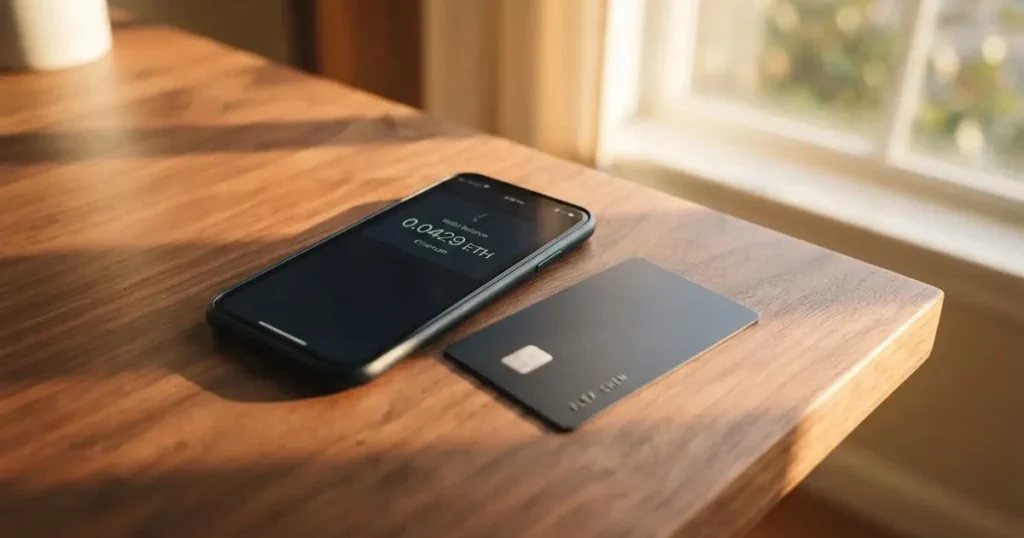
The OKX card is a euro-denominated virtual Mastercard that spends straight from a stablecoin balance you already hold on the exchange. There is no card fee, no per-transaction fee, and no FX fee charged by OKX itself. In exchange, you give up the physical card, the ATM, and any sense of a hard spending limit — because the card simply draws down whatever USDC or USDG sits in your OKX Pay balance. For EU residents who already hold those two stablecoins and want a clean euro card for subscriptions and online spending, that trade is usually worth it. For everyone else, there are better-fitting alternatives. I score it 6.2 out of 10 overall.
The conditions described below are current as of October 28, 2026.
Verdict: a competent stablecoin card with real gaps
The OKX card is honest about what it is: a thin, low-cost layer between a stablecoin balance and a Mastercard number. It launched across the EU plus Norway on 28 January 2026. Iceland and Liechtenstein are excluded. The card is virtual, denominated in euros, and converted from USDC or USDG at the moment of purchase.
The strongest argument for it is the cost structure. There is no issuance fee, no monthly fee, and no OKX FX fee — the only conversion cost is a spread, and even that number is disputed between sources (0.1% according to the explainer, 0.4% in the launch press release). For high-frequency spenders, that difference is not nothing.
The strongest argument against it is the gap between what you might expect and what actually exists. There is no physical card mentioned. There is no ATM function stated. There are no daily or monthly limits stated. Cashback only applies to USDG purchases — USDC earns none at all, which catches out people who assume the two stablecoins behave identically. And the reliability mark reflects a real pattern of user complaints about the wider exchange, not the card specifically, but the exchange is where your money sits.
Who it suits: EU and Norwegian residents who already hold USDC or USDG, want to spend that balance in euros, and are content with a virtual-only card and Apple Pay or Google Pay.
Who it does not suit: anyone outside the EU and Norway; anyone who needs a physical card or cash from an ATM; anyone who holds only USDC and expects cashback; anyone who wants a card with published spending limits; and anyone uncomfortable holding a stablecoin balance on a centralised exchange.
| Criterion | Mark | Why |
|---|---|---|
| Who can get it | 5 / 10 | EU plus Norway, launched 28 January 2026; Iceland and Liechtenstein excluded |
| Cost | 9 / 10 | Card free, no transaction fee, no OKX FX fee; conversion spread 0.1% per the explainer, 0.4% per the press release |
| Top-up options | 5 / 10 | USDC or USDG on OKX Pay via Convert or external deposit; other coins must be converted first, networks not named |
| Reliability and complaints | 6 / 10 | OKX Europe Ltd. is MiCAR-licensed, issuer unnamed in official text; unofficial reports name Monavate; complaints centre on exchange asset holds, account restrictions, slow support |
| Everyday use | 5 / 10 | Virtual euro Mastercard, Apple Pay and Google Pay; physical card and ATM not named |
| Total | 6.2 / 10 | A cheap, narrow card that does one job well |
The overall picture: a card that removes cost but not complexity. You are still exposed to the exchange’s stability and support quality, and the stablecoin’s peg.
Will they give you the card?
Eligibility is narrower than the marketing might imply. The card is offered to EU residents plus Norway, and the licensed entity behind it for EEA users is OKX Europe Ltd., which holds a MiCAR licence. Iceland and Liechtenstein are excluded. One explainer’s conclusion says “entire EEA,” which is inconsistent with the exclusions — so if you are in one of those two countries, check directly rather than assuming you qualify.
The rule is by EEA user of OKX Europe Ltd. That means your OKX account must sit under that licensed entity, not some other OKX entity. If you signed up before that entity existed in your region, or your account is registered elsewhere, the card may not appear at all.
Beyond geography, you need to pass full identity verification. That means a valid ID document and proof of address — both required. Age is not stated in the card’s public materials; as a general rule across the category, prepaid and debit cards go to adults aged 18 and up, and some issuers set higher thresholds.
There is one verification level for the card: valid ID and proof of address. No tiers, no graduated limits based on how much documentation you provide. Time to approval and reasons for rejection are not stated on the public pages, so do not build a schedule around any particular turnaround.
What is not stated anywhere public: whether a physical card exists. Official material describes a virtual Mastercard only.
How to get it
Getting the card is short. You activate it inside the OKX app, and you need USDC or USDG sitting in your OKX Pay balance. That is the whole sequence as the public explainer describes it.
The card itself: a Mastercard, euro-denominated, virtual, debit, linked to OKX Pay. It is issued via an unnamed European licensed payment provider — the official text does not say who. Third-party reporting names Monavate as the issuer, but that is not confirmed by the card’s own materials.
Delivery is not stated, because the card is virtual. There is nothing to wait for. You activate it in the app and it is usable.
Two practical notes before you start. First, because there is only one verification level, there is no “start small, then unlock more” path — you either clear the checks or you do not. Second, since there is no physical card, if you lose your phone or lose access to the app, your route back in matters more than it would with a card in your wallet. Set up your recovery options deliberately.
Fees and costs: what it really costs
The fee side is where this card earns its strongest mark. Here is the full cost picture as published:
| Fee or limit | What the card says |
|---|---|
| Card fee (issuance) | None |
| Monthly fee | None stated |
| Transaction fee | None |
| OKX FX fee | None |
| Conversion spread | 0.1% per the explainer (May 2026) vs 0.4% market spread per the launch press release — conflict, explainer is newer |
| ATM fee | Not stated |
| Daily limit | Not stated |
| Monthly limit | Not stated |
| Deposit / top-up fee | Not stated |
Take two everyday payments and see what actually happens.
Buying a EUR 30 subscription billed in euro, funded by USDG. The purchase converts USDG to euro at the point of sale. You pay no OKX FX fee and no transaction fee. The only cost is the conversion spread — 0.1% or 0.4% depending on which number is current. On EUR 30 that is EUR 0.03 or EUR 0.12. Effectively nothing.
Paying a EUR 80 bill at a non-euro merchant, funded by USDC. The euro card converts USDC to euro, then the merchant’s own network handles the cross-border leg if the merchant’s acquirer charges for it. The card adds no FX fee of its own, but the merchant’s network exchange rate still applies. So “no FX fee” means OKX charges you nothing extra, not that the payment is rate-neutral.
The honest caveat: the numbers where it matters most — the exact conversion spread — are the ones the sources disagree on. The explainer says 0.1%; the launch press release said 0.4% market spread. The explainer is newer, so 0.1% is the more likely current figure, but the conflict is worth knowing about.
On cashback: there is a single card with no paid tiers, and cashback depends on your OKX VIP level — and only on USDG purchases. USDC earns nothing. Monthly caps in euro: Regular 2% capped at EUR 10; VIP1 4% capped at EUR 300; VIP2 4.5% capped at EUR 450; VIP3 5% capped at EUR 1,000; VIP4+ 10% capped at EUR 1,000. Rates are from 29 May 2026. One unofficial note: a German deals-forum post claimed a monthly limit was raised to EUR 50 for a cashback promotion — unverified, and it may not even be the card’s spending limit.
Top up: how the balance gets there
The balance is USDC or USDG held in OKX Pay. You get it there two ways: through Convert inside OKX Pay, or by depositing USDC or USDG from an external wallet. Any other coin you hold has to be converted to USDC or USDG first — the card does not spend BTC, ETH, or anything else directly.
There is no auto top-up. If your balance is insufficient, the payment is declined. That is worth internalising: this is a pre-loaded balance model, so the card cannot overdraw, but it also will not rescue a payment you forgot to fund.
What is not stated: any deposit fee, the minimum top-up amount, and the network fees for the transfer. The card’s public pages do not name which networks to use for the deposit, which is the single most important practical detail for sending stablecoins to an exchange — sending on the wrong network can lose the funds.
One thing that is stated and easy to misread: the stablecoins stay in your own wallet until checkout. That is true of the purchase moment, but the balance you are spending from is the one held in OKX Pay. So your funds are on the exchange, not on the card. “Withdraw-out” arrangements for funds already loaded are not stated.
If you are depositing from an external wallet, treat the network question seriously. On-chain transfers are charged by the blockchain, not by OKX. Transfers are irreversible, and a deposit sent on an unsupported network, or to an address of the wrong network, can be lost or need manual support recovery with no guarantee. Find out the supported network before you send, not after.
Paying with it every day
Day-to-day, the card works as a euro Mastercard in your phone. Apple Pay and Google Pay tap-to-pay are supported. Whether any merchants are blocked is not stated.
Two payment features matter more than they sound. First, address verification: the system that compares the billing address you type with the issuer’s records is mainly offered in the US, Canada, and the UK, and is generally unavailable for foreign-issued cards — which can cause declines. A euro card paying a US merchant sits exactly in the zone where address verification helps least. Second, prepaid and foreign BINs: some merchants decline them because the BIN lookup reveals the card type and issuer country. So a euro-denominated card paying, say, a Japanese merchant can look “foreign” and attract extra scrutiny or a decline. Not a defect in the card, just the reality of how card acceptance works.
Declined authorisations can leave a hold on your funds for several days — typically up to seven. That is standard across cards and worth knowing if a purchase bounces and your balance looks short.
3-D Secure adds an identity step to online payments. Visa’s brand is Visa Secure, Mastercard’s is Identity Check. Fraud liability can shift under 3-D Secure, but do not read that as insurance.
On the app itself: the OKX app with OKX Pay scores 4.6 out of 5 on the App Store from about 23K ratings — but note that is the main OKX app, not a card-specific listing. An unofficial mirror of Google Play data puts it at 4.4 from 917,336 reviews. Dispute handling is not stated.
One last everyday-use point on rewards: cashback applies only to USDG purchases, not USDC. If you hold USDC and spend it, you get nothing back regardless of your VIP level.
What can go wrong
The card’s risks are mostly the exchange’s risks, because that is where your balance lives.
OKX Europe Ltd. is the licensed entity for EEA users under MiCAR. The card is issued through “a European licensed payment provider” — not named in official material. Unofficial reporting names Monavate, a UK-headquartered e-money institution, on Mastercard. Either way, the entity holding your funds is an exchange, and exchanges have a history.
User complaints, aggregated: Trustpilot shows about 1,619–1,621 reviews; OKX Europe shows 4.3 from 29 reviews. The recurring negative themes are assets held with no clear reason, account restrictions blocking access to funds, withdrawal holds, and slow support. App Store reviews say the same. An aggregator notes public reviews often cite slow support and region-dependent verification and withdrawal experiences, with regional availability driving mixed card and fiat experiences. OKX has a complaints section on SikayetVar. Official incidents specific to the card are not stated.
If due diligence cannot be completed, EU rules require the institution to decline the transaction or end the relationship. That is why accounts get closed or frozen pending documents — and it is the mechanism behind many of the complaints above. Your money is not inaccessible by accident; it is inaccessible by rule.
On security specifics: the launch release says stablecoins remain in your self-custody wallet until checkout. KYC is required under MiCAR and EU anti-money-laundering rules. Whether you can freeze the card, whether 2FA is available, and whether funds are insured are all not stated. Support contact details are not stated on the public pages.
Market risk sits underneath all of this. Stablecoins can and do depeg — TerraUSD collapsed in May 2022, USDC temporarily lost its peg in March 2023 during the US banking crisis. Your “euro balance” is a USDC or USDG balance until the moment of purchase, and in a stress event that conversion is where the pain shows.
What is not stated that you should still care about: withdrawal rights from OKX, dispute resolution, and ATM access. And on tax — I am not giving tax advice, but note that in the US the IRS treats digital assets as property, so each card payment funded from crypto can be a separate disposal measured at fair market value on the transaction date. That is a general principle, not a statement about your jurisdiction.
What to take instead
The OKX card sits in a crowded field, and the alternatives are not uniformly better — they trade different things away. Here is how the main ones compare on score:
| Card | Score | Card type | Who can get it | Key fee |
|---|---|---|---|---|
| OKX | 6.2 / 10 | Virtual euro Mastercard | EU + Norway | No card fee, no FX fee, conversion spread 0.1–0.4% |
| Coinbase Card | 6.4 / 10 | Visa prepaid debit, virtual or physical | All US states except Hawaii | No spending or annual fees; spread on conversion |
| Bybit Card | 6.0 / 10 | Virtual and physical, Visa/Mastercard | Argentina, AIFC, Georgia, Kazakhstan, Australia, Mexico, Brazil, Peru, Asia Pacific | 0.9% crypto conversion in most regions, plus 2% FX |
| BingX | 5.8 / 10 | Virtual (instant) and metal Visa debit | Europe, APAC, LATAM, selected regions | Not stated; USDT only |
Coinbase Card scores slightly higher and is physically real. It is a Visa prepaid debit, virtual or physical, spending cash or crypto with all crypto converted to US dollars. It has zero spending fees and no annual fees, with the spread applying when Coinbase converts. Funding is by linking a bank account or depositing part of a paycheck. Rewards are optional crypto back on every purchase, US users only, with a variable rate. Its hard limit: US only, all states except Hawaii.
Bybit Card has the widest geographic reach of the four, but it explicitly says the product is not meant for EEA customers and that all EEA participation is strictly prohibited. Its costs are heavier: 0.9% crypto conversion over the One-Click Sell rate in most regions, 2% FX on top of the network rate in several. It has real tiers — Base 2% up to 5 USD, up to Omega 8% and Infinite 10% at 600 USD — but from 5 October 2026 only crypto-funded transactions earn points or cashback; fiat-funded spending earns nothing.
BingX is the weakest of the four on score and the vaguest: no country list, fees not stated, USDT only for now, no cashback mentioned. Its one advantage is a metal card, mailed in 15–30 business days.
If you are in the US, Coinbase is the straightforward pick. If you are in one of Bybit’s named countries and want a physical card, Bybit covers more ground than OKX does. If you are in the EU and want a metal card, BingX lists Europe but confirms nothing.
Who I would recommend it to
I would recommend the OKX card to you if all three of these are true: you live in the EU or Norway, you already hold USDC or USDG (not just USDC), and you are content with a virtual-only card used mainly through Apple Pay or Google Pay.
Under those conditions it is hard to argue with the economics. No card fee, no monthly fee, no FX fee from OKX, and a conversion spread that is either 0.1% or 0.4%. For someone spending a few hundred euros a month, that difference versus a 2% FX fee or a 0.9% conversion fee elsewhere is real money over a year.
I would steer you away if you need cash from an ATM, if you want a physical card in your wallet, if you spend mainly in the US and care about address verification working in your favour, or if you hold only USDC and were counting on cashback. I would also think twice if holding your balance on a centralised exchange makes you uneasy — the complaint themes around asset holds and account restrictions are consistent enough to be worth weighing.
And if you are outside the EU and Norway entirely: this card is not for you, and no amount of account-opening will change that.
Frequently asked questions
What is the OKX card?
The OKX card is a euro-denominated virtual Mastercard that draws on a stablecoin balance held in OKX Pay on the OKX exchange. You spend USDC or USDG, and the balance is converted to euro at the moment of purchase. It launched in the EU plus Norway on 28 January 2026. It is virtual only — no physical card is mentioned in the official material — and works through Apple Pay and Google Pay tap-to-pay.
Is OKX a bank, and who owns it?
No — OKX is a cryptocurrency exchange, not a bank. The entity serving EEA users is OKX Europe Ltd., which holds a MiCAR licence, and the card is issued through an unnamed European licensed payment provider. Third-party reporting names Monavate as the issuer, but that is not confirmed by OKX’s own materials. An electronic money institution can issue cards and e-wallets but cannot lend, and its funds are safeguarded rather than bank deposits.
How do I get the OKX card?
You need to be an EU or Norwegian resident with an account under OKX Europe Ltd., pass full identity verification with a valid ID and proof of address, and hold USDC or USDG in OKX Pay. Then you activate the virtual card inside the OKX app. There is one verification level only, no tiers, and no stated approval time or rejection reasons. Iceland and Liechtenstein are excluded.
What does the OKX card cost?
There is no card fee, no monthly fee, no transaction fee and no OKX FX fee. The only cost is a conversion spread, which sources disagree on: 0.1% in the explainer versus 0.4% in the launch press release, with the explainer being newer. On a EUR 30 purchase that is somewhere between three and twelve cents. ATM fees and daily or monthly limits are not stated.
How do I top up the OKX card?
You fund it by holding USDC or USDG in OKX Pay, either through Convert inside OKX Pay or by depositing from an external wallet. Any other coin must be converted to USDC or USDG first. There is no auto top-up, and if the balance is insufficient the payment is declined. Check which network to use before sending a deposit — the card’s public pages do not name the supported networks.
Does the OKX card require KYC, and is it safe?
Yes, full identity verification with valid ID and proof of address is required, under MiCAR and EU anti-money-laundering rules. Whether you can freeze the card, whether 2FA is offered, and whether funds are insured are all not stated. The stablecoins stay in your wallet until checkout, but your balance sits on a centralised exchange — and user reviews consistently cite asset holds, account restrictions and slow support.
Can I use the OKX card in my country?
Only in the EU and Norway. Iceland and Liechtenstein are explicitly excluded, despite one explainer claiming “entire EEA” — so check directly if you are in one of those. Outside the EU and Norway the card is not offered at all. One unofficial note suggests a monthly limit was raised to EUR 50 for a promotion, but that is unverified and may not be the card’s spending limit.
Is the OKX card free, and does it give cashback?
The card itself is free. Cashback depends on your OKX VIP level but applies only to USDG purchases — USDC earns none at all. Monthly caps in euro: Regular 2% up to EUR 10, VIP1 4% up to EUR 300, VIP2 4.5% up to EUR 450, VIP3 5% up to EUR 1,000, VIP4+ 10% up to EUR 1,000. Rates are from 29 May 2026. Promotional offers vary.
Is the OKX card worth it compared to Coinbase or Bybit?
For EU and Norwegian residents already holding stablecoins, yes — no card fee, no FX fee, and a 0.1–0.4% conversion spread beats Bybit’s 0.9% conversion and 2% FX. Coinbase Card scores slightly higher but is US-only. Bybit covers far more countries but excludes the EEA explicitly and costs more. If you need a physical card, OKX does not have one.
Exchange cards – cryptocardsranked
Content created by the «cryptocardsranked» team