
A euro-first Visa for people locked out of banking — good bones, unfinished paperwork
 Available in US
If you are reading this, the odds are you have been turned down a bank account, refused a mainstream card, or live somewhere where a normal Visa is simply not something you get. That is the person Rebind is built for, and that is the lens I have reviewed it through: not whether it is a nice piece of fintech, but whether it does the one job a person in that position needs done. Short answer: it does that job in several countries, quietly well, with a real Visa and real euro balances — but it asks you to accept unknowns where a bank would give you paperwork. Rebind scores 5.8 out of 10 for exactly that balance. It suits euro savers who want their balance to earn something and want a plain Visa to spend it with. It does not suit you if you live mainly in dollars or pounds, if you need Apple Pay, if you want to be certain who issued your card, or if you intend to treat the yield as a savings account.
Conditions on this page are current as of October 28, 2026.
Verdict: a useful card with more blanks than a bank would leave
Rebind gets a fair amount right. The card is free, the euro balance is genuine e-money issued by a licensed EU institution, top-ups by IBAN are instant and cost nothing, and the money you are not spending sits in something that pays interest rather than paying zero. For someone whose only alternative is no card at all, that is a real improvement, and I do not want to be squeamish about it.

But the same review that finds those virtues finds that a lot of what you would want to know is simply not written down. The card issuer’s name is not published. ATM fees are not stated. Daily and monthly spending limits are not stated. The crypto top-up path — the thing most people arrive wanting — appears only in third-party listings, not on the card’s own pages. And the complaints that third parties report, about cashback tied to holding a specific token and a performance fee on the yield, land precisely on the part of the offer that sounds most attractive on the surface. None of that is disqualifying on its own. All of it together is why this lands in the middle of the scale rather than the top.
Here is the score broken down, criterion by criterion.
| Criterion | Mark | Why |
|---|---|---|
| Who can get it | 5 / 10 | Works in 40+ countries inside and outside the eurozone; the full list sits on a linked guides page; third-party listings say EU, EEA and UK only |
| Cost | 8 / 10 | No account fees, no transfer fees, no foreign exchange fees, no minimums; buying and selling assets carries a “small fee” with no amount given; unofficial reports of a 1.5% markup outside EUR and GBP |
| Top-up options | 4 / 10 | Officially IBAN only, with crypto not disclosed; unofficial sources name ETH and USDC on Gnosis Pay infrastructure |
| Reliability and complaints | 5 / 10 | Rebind SAS has no banking licence, the euro is issued by Monerium as an EMI, the card issuer is unnamed, no deposit insurance; unofficial complaints about cashback tied to GNO and withdrawal delays |
| Everyday use | 6 / 10 | Free Visa, spend euros globally; unofficial reporting says virtual and physical, free ATM withdrawals, no Apple Pay or Google Pay |
| Total | 5.8 / 10 | Strong cost structure, thin on published detail and on the crypto side |
The honest summary of who this suits: a person in the eurozone, or a nearby country on the unofficial list, who already holds euros or can get them, who wants the balance to earn, and who is content to manage the card through the app with a virtual card number. Who it does not suit: someone spending mostly in dollars or pounds, someone who lives outside the regions a third-party listing names, someone who pays by phone wallet as a matter of habit, or anyone for whom “which company actually issued my card” is a dealbreaker rather than a footnote.
Who will they give you the card
The card’s own claim is short: Rebind works in 40+ countries, inside and outside the eurozone, and the full list sits behind a linked guides page. Inside the eurozone, that is what you would expect from a Paris-built company with an EU e-money issuer behind it. Outside it, the claim gets vaguer fast, and the third-party card comparison sites — unofficial, not confirmed by Rebind — narrow it to the EU, the EEA and the United Kingdom. Treat the first claim as marketing breadth and the second as the more probable practical boundary, and check the guides page yourself before you plan a move around it.
That distinction matters more here than it would for an ordinary card, for a structural reason. Nationality is recorded and screened separately from residence, because sanctions screening and issuer risk policy are applied to citizenship and country of birth as well as to country of address. So the practical question is not only where you live but which passport you hold. Someone living in a supported country while holding an ID from a restricted region may still fail identity checks — that pattern shows up repeatedly in this category, and it is worth assuming it applies to you or does not before you invest an afternoon in the sign-up.
One more thing about the setup that shapes everything else: Rebind describes itself as a technology company without a banking licence. The euro balance is not a bank account. It is e-money issued by Monerium, an EU-licensed electronic money institution. The card itself comes through what Rebind calls a licensed, MiCA-compliant card-issuing partner, and that partner is not named. This is the normal architecture for this whole category — the card network sets the rules, the licensed issuer holds the programme, and the crypto brand is often just the front end — but it means you are a customer of a company whose legal name you cannot look up from the card’s own pages.
How to get it
Officially, the promise is “Free to open. Only takes 5 min.” The documented steps are short: sign up in the app, and get the card in the app. That is genuinely all the card’s public pages say about applying, and the gap is significant. The documents you will need are not stated. Proof of address is not mentioned. Minimum age is not mentioned. Whether identity checks happen at sign-up or later is not stated. Delivery time for a physical card, if one is issued, is not stated.
What a third-party comparison site reports for 2026 — unofficial, and not confirmed by the card — is that an email address, a phone number and an ID document are required, and that proof of address and a selfie are not. Take that as orientation rather than as a checklist, because the same category of provider typically raises requirements later, often under anti-money-laundering rules that require identity documentation, a sanctions check and an assessment of whether you are a politically exposed person. In the EU, customer due diligence covers name, address, date of birth, nationality and identity documentation. If that process cannot be completed, the institution is required to hold back the transaction or the relationship — and where necessary, end it. Accounts closed “pending documents” are a normal feature of this industry, not a personal failure.
On what you end up holding: officially a free Visa, with an account in euros that Monerium issues as e-money, spendable globally, payable in any currency. Whether that is a physical card, a virtual one, or both is not stated on the card’s pages; third-party listings for 2026 say both, virtual and physical Visa. One App Store reviewer says the virtual card can only be added to mobile wallets by manual card entry — which, if it is still true, tells you something important about how the phone-wallet story works here.
Before you start, then, you have one real question to ask: are you eligible today, in your country of residence, with your passport? Everything else is short.
Fees: what a Rebind payment really costs
The published cost story is the strongest thing about this card. “No account fees.” No transfer fees, no foreign exchange fees, no minimums. Buying or selling assets inside the app carries what the card calls a “small fee”, with no amount attached, and the conversion spread is not stated either. There are no tiers: nothing to upgrade to, no per-tier prices, just “free to open”. Savings are advertised from 1€.
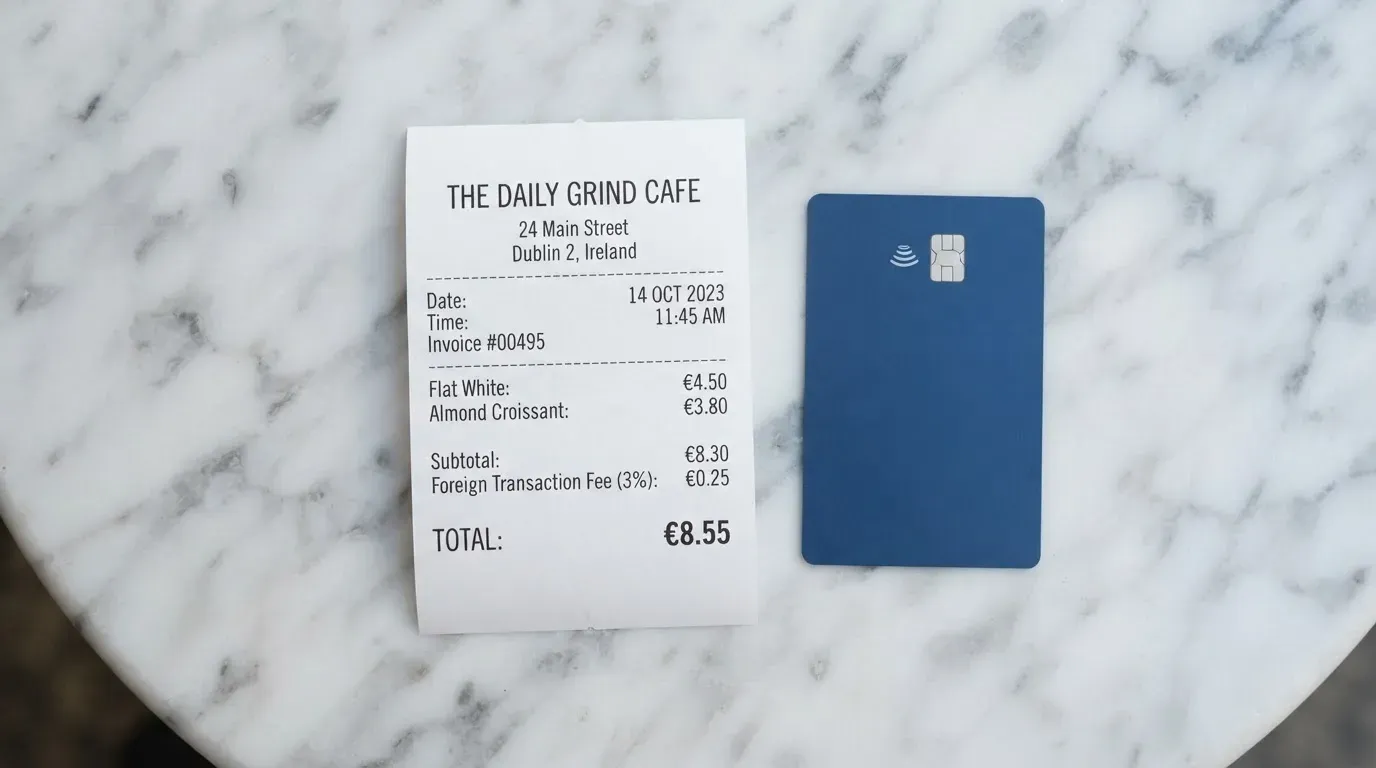
Then the costs the card does not publish.
| Fee or limit | What the card states |
|---|---|
| Account fee | None — “No account fees” |
| Card cost | Free |
| Monthly fee | Not stated |
| Transfer fee (IBAN top-up) | None — “no transfer fees” |
| Foreign exchange fee | None — “no foreign exchange fees” |
| Minimum amounts | None — “no minimums” |
| Buying/selling assets | “a small fee”, amount not stated |
| Conversion spread | Not stated |
| ATM fee | Not stated (unofficial listings say free) |
| Daily limit | Not stated |
| Monthly limit | Not stated |
| Tiers | None stated |
What this means for three ordinary payments:
A coffee in your own city. You tap or insert, the network routes it, the issuer authorises it, and the amount leaves your euro balance. No account fee, no monthly fee, no per-transaction card fee is published, so on the face of it a euro purchase inside the eurozone costs you the price of the coffee. The unstated spread and the unstated small fee on asset conversion only bite if you convert.
A meal in a country that is not the eurozone. The card says “spend euros globally” and “no foreign exchange fees”, and that is a genuinely unusual thing to read on a card that is not backed by a bank. What it does not resolve is who absorbs the cost of the conversion. Here is where the unofficial reports get relevant: third-party listings and user reports describe a 1.5% markup on spending in currencies other than EUR and GBP. If that is accurate, then your “no FX fee” foreign meal quietly costs one and a half percent, and nobody will present it to you as a foreign transaction fee. I would treat 1.5% as the number to plan around and ask Rebind directly what the actual cost is.
Anything bought or sold inside the app. The “small fee” on buying or selling assets is not quantified, so you cannot compute the cost of turning euros into a token and back. Since the yield is the headline feature and the yield lives in the crypto side, this fee may be the number that matters most to you, and it is the one the card publishes least clearly.
One thing worth internalising: on-chain network fees for a crypto deposit are charged by the blockchain, not by the card provider. Whatever gas costs on the network you send on is added to what you pay to top up.
How to top it up
The official answer is a bank account. The card advertises an IBAN with “Instant transfers 24/7 at no cost”, and repeats that there are no transfer fees and no minimums. That is the whole documented funding story: euros in, from your own bank account, whenever you like, at no cost, from as little as the savings start of 1€.
The crypto answer is not on the card’s pages. Third-party sources for 2026 — unofficial, not confirmed by Rebind — say the supported coins are ETH and USDC, and that the build runs on Gnosis Pay infrastructure. If that is right, it is a meaningful difference: it means you could fund from a self-custodied wallet rather than routing through a bank, which for exactly the reader this card is built for may be the difference between usable and not usable at all. But I would not plan a payment around it until Rebind confirms it, because two separate costs can bite you here.
The first is getting the asset onto the network. Gas on Ethereum is paid in ETH, so a wallet holding USDC and no ETH cannot send anything. If you are on Ethereum or another network where fees are burned from a different coin, that coin has to be in the wallet first. Tron-based transfers price differently, burning TRX, and one point to keep in mind: Circle stopped supporting USDC on Tron in February 2024, so “USDC over TRC20” is not a native option.
The second is the one that loses money without any warning. Blockchain transfers are irreversible. Send on a network the card does not support, or to an address belonging to a different network, and the funds can be gone or be recoverable only through a manual support request with no guarantee attached. There is no undo button and no chargeback on a chain transfer. So: confirm the exact network and the exact address from Rebind’s own current screen, every time, and treat a small test deposit as mandatory rather than anxious.
Savings, for completeness, are advertised as “available at any time”, with no lock-ups — which is friendlier than most yield products. How you actually withdraw them, and what that costs, is not explained on the pages I could read.
Paying with it every day
Day to day, Rebind is a prepaid card that happens to connect to crypto. Your balance is loaded first, and the card spends only that balance, so it cannot overdraw and you are not extending credit to a shop. The card is Visa, so acceptance is the Visa acceptance you already know.
What is genuinely attractive: the euro balance pays interest. The card advertises up to 5% on euros and up to 8% on US dollars, paid every second, variable, and not guaranteed — the money comes from third-party DeFi protocols, which is exactly the sort of yield that can also be negative in a bad week. Paid every second means the number on the screen is live, which is a nice touch and also a reminder that it moves.
What is missing: Apple Pay and Google Pay. Third-party listings for 2026 say neither is supported, and one App Store reviewer says the virtual card must be added to wallets by manual card entry — that is, typing the card number in by hand rather than scanning a QR code. If you pay by phone as a matter of routine, this alone settles the question for you. Also not stated: whether any merchant categories are blocked. In this category that usually means gambling, coded MCC 7995, which issuers block by policy rather than by law, and the blocked list varies by issuer. Merchant-category blocks and blocked card numbers are things to ask about, not things to discover at a till.
Then there are the standard card-world things you may not have had to think about. Online payments usually run 3-D Secure, Visa’s version called Visa Secure, which either approves silently or challenges you with a one-time code or a biometric check. Address verification, which compares the numeric parts of your billing address with the issuer’s records, is mainly offered in the US, Canada and the UK and is generally unavailable for foreign-issued cards — a common reason a legitimate purchase gets declined abroad. And merchants can look up the issuing institution and country from the card’s first six or eight digits, and may apply extra scrutiny when the issuer country differs from your billing address. A card issued in one country can look “foreign” to a shop in another. None of that is Rebind-specific, but it is what you are signing up for if a card is new to you.
Disputes, refunds and chargeback handling are not stated. A declined authorisation can leave a hold on your balance for several days. I would not want to learn about Rebind’s dispute process at the moment I need it, so put it on the list of things to ask.
What can go wrong
Rebind’s own pages carry no complaints section, and I found no Trustpilot page for Rebind. That is not a clean record; it is an absence of record, which for a young financial product is unremarkable and still worth weighting as unknown.
What third parties report is a different matter, and it is worth reading carefully because the complaints target the attractive part. All of the following is unofficial, from a single aggregator’s user-report and news-style summaries, unverified, with no dates attached:
- Cashback described as depending on holding GNO tokens, with weekly caps on the advertised rate. If true, the headline cashback is not a flat reward — it is a function of a position you have to hold, which means it is not income, it is a token exposure wearing a reward’s clothing.
- A 15% performance fee charged on yield. Read that against “up to 5% paid every second” and do the arithmetic yourself before you treat the rate as yours to keep.
- A reported 1.5% markup on spending outside EUR and GBP, in tension with the advertised absence of foreign exchange fees.
- Delays of several days when withdrawing from yield contracts. If the funds are “available at any time” but the withdrawal path passes through a third-party DeFi protocol, those two statements are describing different things.
- No deposit insurance, and availability limited to EU, EEA and UK.
There are also aggregator ratings that disagree with each other: 8.3/10 on the English page, 6.2/10 on the Russian, French and Chinese ones. When the same page rates a product three ways, the most reasonable conclusion is that the score is measuring a mixture of the product and the reviewer. One App Store reviewer also reports that the virtual card can only be added to mobile wallets by manual entry.
On protection, be clear about what you have and what you do not. Rebind says it does not custody assets — stablecoin holdings are owned and custodied by you — and that the euro balance is e-money, not a bank deposit. That means it is not covered by the French deposit guarantee scheme or any equivalent. E-money institutions must safeguard customer funds by segregating them in dedicated accounts or insuring them, and that safeguarding is a different thing from a deposit guarantee: it protects against the institution misusing the money, not against the institution failing. The provider’s guide on protecting money mentions passkey and biometric protection without going into detail. Whether you can freeze the card instantly, set spending limits, or do either of those things from the app is not stated — and instant freeze plus limits are the two controls I would want in any card I hold.
One risk belongs to this whole category, not to Rebind specifically. Card programmes do close. Visa terminated its global agreements with FTX on 13 November 2022 and the US debit card was wound down; WaveCrest, a Visa issuer that supplied several crypto card brands, was suspended by Visa in Europe in 2018 and all its programmes shut. Closures typically follow a pattern: a notice period, then loading and spending stop, then users are asked to withdraw what is left. When you hold a balance, you are holding a claim on a chain of companies — brand, programme manager, issuer, e-money institution — and your exit depends on all of them operating at once.
I would add a tax note without giving you tax advice: if the balance is funded from crypto, each payment funded that way can be a separate disposal in the local fiat currency, valued on the date of the transaction. What you do with that depends entirely on where you live. Talk to someone qualified in your jurisdiction.
What to take instead
If the deciding factor for you is not “can I get a card at all” but “which card is best”, the comparison changes shape entirely. Here is where the alternatives stand against Rebind’s 5.8.
| Rebind | MetaMask | KAST | Zeal | |
|---|---|---|---|---|
| Score | 5.8 / 10 | 7.1 / 10 | 6.1 / 10 | 6.1 / 10 |
| Network | Visa | Mastercard | Visa | Visa |
| Card form | Physical/virtual not stated officially | Virtual instant; metal $199/year | Virtual and physical, up to 10 cards | Virtual; physical not stated |
| Account fee | None | None on virtual | Standard 0 USD; Premium 1,000 USD/year; Private 10,000 USD/year | Not stated |
| Where | 40+ countries claimed; unofficial EU/EEA/UK | 45 listed countries, others waitlist; US/UK sign-ups temporarily closed | Residence-based at KYC, list not published | 150+ countries to spend; EU/UK/Brazil/Colombia/Mexico/Japan/Singapore/Philippines/Indonesia/Thailand live |
| Funding | IBAN officially; unofficial ETH and USDC | Wallet balance, named tokens | Stablecoins: USDT, USDC, PYUSD, RLUSD | Card Safe balances in EUR/USD/GBP |
| Cashback | Not stated | 1% virtual, 3% headline on metal up to $10,000 then 1% | 1.5% / 2% / 3% by tier, with monthly caps | Up to 4%, paid in GNO, must hold GNO |
MetaMask Card scores highest of the four at 7.1, and for you the deciding factor may not be the score. It is a Mastercard, and it spends directly from your connected wallet across named networks with named tokens. What holds it back for this particular reader: sign-up is open in 45 listed countries with other regions on a waitlist, proof of residency is required, and US and UK sign-ups are temporarily closed per its own FAQ. The metal card costs $199 a year. And the cashback footnote is the sort of thing to read twice: 3% applies only to the first $10,000 spent, then it drops to 1%.
KAST is the most transparent on the things Rebind leaves blank — its membership pricing, its cashback caps and its FX fees are all published, which is not a compliment by default but should be. The catch is the price of looking: Premium is 1,000 USD a year and Private is 10,000 USD a year, billed annually upfront with no monthly option. Its non-USD FX fee runs 0.5% to 1.75% depending on where you live, where you are spending and which card programme you hold. Its eligibility is checked at KYC against a country list it does not publish.
Zeal is the closest cousin to what Rebind is trying to be: a Visa with euro balances, up to 4% cashback paid in GNO, accounts in EUR, USD and GBP, spendable in 150+ countries, no additional FX fee with conversion at the Visa wholesale rate. Two things to weigh. Its cashback requires holding GNO in the card Safe — the same structural issue as the Rebind complaints. And its cost schedule is not published at all, so I would be asking rather than assuming.
Each of these is a different bet for a different person. Rebind’s bet is: euro-first, cheap, generous on paper, and thin on disclosure. If disclosure is what you are missing rather than access, any of the other three serves you better.
Who I would recommend it to
I would recommend Rebind to someone who has no ordinary card available, who holds or can obtain euros, who is comfortable managing the product in an app, and who treats the interest rate as a variable bonus rather than a plan. Under those conditions it is a good card: free, no FX fee claimed, instant free IBAN top-ups, real Visa acceptance, and a balance that pays something while it sits. That is more than most people in that position are offered.
I would not recommend it as your only card, for two reasons that are about structure rather than quality. The first is the missing issuer name. Rebind’s pages name Monerium for the e-money, name Visa as the network, and show logos for Stripe, Visa, Privy and Gnosis Pay without stating which of them issues the card. An unnamed issuing partner is normal for this category and is still an unnamed partner. The second is the yield: a variable rate drawn from third-party DeFi protocols, with third-party reports of a 15% performance fee and multi-day withdrawal delays, is a different risk category from a bank deposit, whatever the app displays.
Before you commit, ask four questions and see how straight the answers are. Who issues the card? What does a payment in a non-euro currency actually cost me? What are the daily and monthly limits? And what exactly happens to my balance if the app or the programme stops? A provider that answers those plainly is worth a great deal more than the headline rate, and a provider that does not has just told you something.
If your answer to any of them is unsatisfying, look at KAST or Zeal for disclosure, or MetaMask if your region and wallet situation fit it. And if the reason you are here is a rejected application rather than an interest in yield — then the honest first step is not a card review at all, but finding out which licensed institution in your country will have you, because the e-money route has more doors than it appears to.
Frequently asked questions
What is the Rebind card?
It is a free Visa that spends from a euro balance, built by Rebind SAS in Paris. The euro balance is e-money issued by Monerium, an EU-licensed electronic money institution, and Rebind itself is a technology company without a banking licence. The balance pays advertised interest and the card is meant for spending globally.
Is Rebind a bank?
No. Rebind states plainly that it is a technology company without a banking licence, and the euro you hold is e-money rather than a bank deposit. That money is safeguarded by the issuer, but it is not covered by a deposit guarantee scheme such as FGDR or any national equivalent.
Who owns Rebind?
Rebind SAS, built in Paris. Who issues the physical card is not stated on the card’s pages; Rebind refers to a licensed, MiCA-compliant card-issuing partner without naming it, and the logos shown include Stripe, Visa, Privy and Gnosis Pay without indicating which issues.
Is the Rebind card free?
Yes as far as the card’s own pages go: no account fees, no transfer fees, no foreign exchange fees and no minimums. There are no tiers. Buying or selling assets inside the app carries what Rebind calls a small fee, with no amount published.
Which countries can use the Rebind card?
Rebind says 40+ countries, inside and outside the eurozone, with the full list on a linked guides page. Third-party listings for 2026 narrow it to the EU, EEA and UK, and that is unofficial. Eligibility also depends on your passport, not only where you live.
Does the Rebind card require KYC?
The card’s pages say only that opening is free and takes five minutes, and list no documents. Third-party sources for 2026 say email, phone and ID document, with no proof of address or selfie — unofficial and not confirmed. Expect EU-style checks covering identity documents, a sanctions check and PEP screening.
Can I add the Rebind card to Apple Wallet?
Third-party listings for 2026 say Apple Pay and Google Pay are not supported, and one App Store reviewer says the virtual card must be added to wallets by manual card entry. The card’s own pages do not mention either wallet. If phone payment is how you pay, treat this as a no.
How do I top up the Rebind card?
Officially by IBAN, with instant transfers 24/7 at no cost and no minimums — that is the whole documented method. Unofficial sources for 2026 name ETH and USDC on Gnosis Pay infrastructure. Send only on a network Rebind confirms, because chain transfers are irreversible.
Is the Rebind card safe to use?
Judge it as an e-money product, not a bank account. There is no deposit insurance, the card issuer is unnamed, freeze and spending controls are not stated, and third-party user reports describe a 15% performance fee on yield plus multi-day withdrawal delays from yield contracts.
Is the Rebind card worth it?
For someone who cannot open an ordinary account and holds euros, the free card, free IBAN top-ups and a paying balance make it worth it. For everyone else, the missing issuer name, the unstated limits and ATM costs, and the reported non-EUR markup make a more transparent card the better choice.
Wallet cards – cryptocardsranked
Content created by the «cryptocardsranked» team