
The Etoro Money card, read carefully before you apply
 Available in US
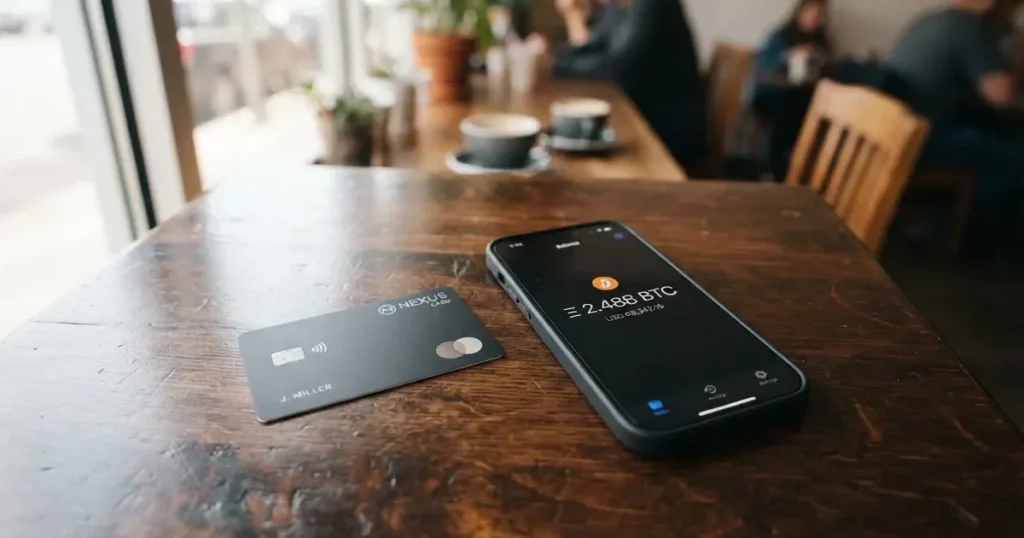
Etoro Money is a Visa debit card issued to people who already use eToro as a brokerage. The promise is straightforward: convert crypto in the eToro wallet, load the proceeds onto a euro or pound account, and spend that balance anywhere Visa is taken. The reality, once you read the small print, is more limited, and the card works best for a fairly narrow audience.
Conditions are current as of October 28, 2026.
The conditions described here are current as of October 2026.
Verdict
The Etoro Money card scores 6.8 out of 10. The cost side is genuinely strong: no monthly fee, no issuance or maintenance charge, no foreign-exchange fee, and free delivery. What pulls the score down is the gated access: only EU and UK residents qualify, and only those who have climbed the eToro Club tier system. Topping up is also limited, because the card spends a fiat balance that you fund by converting crypto through the eToro crypto wallet, with no automatic top-up from a bank card.
| Criterion | Mark | Why it scores that way |
|---|---|---|
| Who can get it | 5 / 10 | EU and UK residents only, and only at the right Club tier |
| Cost | 9 / 10 | No subscription, free issue and maintenance, no FX fees, but the crypto conversion fee is not published |
| Top-up options | 4 / 10 | Card draws a fiat account; crypto must be converted first, and the euro account is funded by SEPA only |
| Reliability and complaints | 8 / 10 | Issued by eToro Money Malta Ltd and eToro Money UK Ltd, FCA-authorised for e-money, customer funds held separately; Trustpilot for the wider eToro brand is 4.0 from 32,233 reviews, with no card-specific complaints found |
| Everyday use | 7 / 10 | Visa debit, Apple Pay and Google Pay available, decent ATM allowance; physical/virtual and metal details not confirmed on the page |
The card suits EU and UK residents who are already investing on eToro and want a simple way to spend from their crypto holdings without setting up a separate card with a crypto-native issuer. It does not suit non-EU, non-UK residents, casual crypto users without an eToro brokerage account, or anyone who wants to spend stablecoins directly without conversion friction.
Who they will give the card to
The card is restricted by residence and by your standing on the eToro platform.
Residence. The card is offered only to residents of the EU and the UK. The official pages point to a separate availability page for the country list, which I have not read in detail. If you live outside those two blocs, the card is simply not part of the offer, regardless of whether you have an eToro trading account.
Club tier. Inside the eToro system, you have to be a member of the eToro Club to qualify. The UK page describes the requirement as “etoro Club member”. The EU pages are slightly inconsistent: one FAQ says the EU card is for Diamond members only, while another lists Diamond, Platinum+ and Platinum. The fee page reconciles this by tying the card tier to your Club tier: the Green card is for Silver through Platinum, and the Black card is for Platinum+ and Diamond. In other words, the same gating exists on both sides of the Channel; it is just described slightly differently in different places.
Account currency. You also need a euro account (EU) or a pound account (UK). The card is linked to that local-currency account, and holding both a euro and a pound account at the same time is “not currently possible”. A footnote on the same page also mentions AUD and DKK accounts, but does not state whether a card can be issued against those.
Verification depth. The eToro Money pages do not list the KYC documents you will be asked for. The stated requirements are residence, Club membership and a euro or pound account. What level of identity check is needed, how long it takes, and on what grounds an application can be rejected are not stated.
How to get the card
The signup path is not a separate application; it is gated by your existing eToro relationship.
You start with an eToro brokerage account and a euro or pound Money account. To meet the residency rule you need to live in the EU or the UK. To meet the Club rule you need to have reached the right tier on the eToro Club ladder (Silver for the Green card, Platinum+ for the Black card, by the fee page). Once those are in place, the card becomes available inside the eToro Money app.
The card is a Visa debit. Whether the default issue is a virtual card, a plastic card, or a metal card is not stated on the pages I read, and the card is not described as either virtual-first or physical-first.
Delivery is free on both tiers for the first card, whether you choose standard or urgent shipping. Replacement cards are also free, up to three per year on a pound account. On a euro account, the Green card is described as N/A for replacement while the Black card is free up to three per year. The delivery time itself is not given on the page; instead, the page links out to a help article for that detail.
Verification steps beyond the residence and Club checks are not stated. If you have already been through eToro’s brokerage KYC, much of the work is likely already done, but the eToro Money pages do not confirm this explicitly.
What it really costs: the Fees table
The headline cost story is the strongest part of this card. There is no monthly subscription, the card is issued and maintained for free, replacement is free up to three per year, delivery is free, and card payments are free. eToro advertises “No FX fees*” abroad, and the asterisk refers to a separate FX terms document that the page links to. ATM withdrawals are free up to a monthly allowance and then 1% above it. The one number you cannot find on the eToro Money pages is the fee for converting crypto to the euro or pound balance the card draws on; you only learn that the conversion goes through the eToro crypto wallet.

| Fee or limit | Amount |
|---|---|
| Card issuance | Free |
| Monthly subscription | None |
| Card maintenance | Free |
| Replacement card | Free up to 3 per year (GBP card; Black EUR card only) |
| First card delivery | Free (standard or urgent) |
| Card payments | Free |
| FX fee abroad | “Zero FX fees*” (see card FX terms) |
| Crypto-to-fiat conversion | Not stated on the eToro Money pages |
| ATM, GBP account, Green | Free up to GBP 2,000 per month, then 1% |
| ATM, GBP account, Black | Free up to GBP 10,000 per month, then 1% |
| ATM, EUR account, Green | Free up to EUR 2,500 per month, then 1% |
| ATM, EUR account, Black | Free up to EUR 12,000 per month, then 1% |
| Daily / monthly card limits | Not stated on the page |
To make this concrete, three everyday situations will show you how the fees actually apply.
Buying a coffee with crypto-funded pounds. You hold bitcoin in the eToro crypto wallet and you want a GBP 4 coffee. First, the eToro app converts some bitcoin to pounds at the rate it quotes you, through the eToro crypto wallet. The crypto conversion fee is not stated on the eToro Money pages. Once the pounds sit in your eToro Money account, the card payment itself is free. There is no separate FX fee because the merchant prices in pounds and your balance is in pounds.
Paying a euro hotel bill from a euro balance. The hotel charges EUR 320 and your euro account is funded. The card payment is free, and because the balance and the merchant are both in euros, no FX conversion is needed. This is the cleanest case for the card.
Withdrawing cash abroad in a third currency. You are on holiday and need EUR 1,000 from a local ATM in, say, Thailand, where the ATM dispenses baht. The card converts the withdrawal from pounds or euros into baht; the page advertises “No FX fees*” on this conversion, with the full terms in a linked document. Above the monthly free allowance, ATM withdrawals cost 1%, and the ATM operator may apply its own fee on top, which is outside eToro’s control.
If the eToro Money pages are silent on one number that matters, it is the crypto conversion fee. The card is positioned as a way to spend crypto through a fiat balance, and the cost of that conversion is the most natural fee to publish, yet it is not.
How to top it up: funding the card
The card does not hold crypto and it does not pull from a debit card at the till. It spends a euro or pound balance that lives in the eToro Money account.
Funding a euro account. Inside the eToro Money app, you open the Wallet tab, pick your euro account under eToro Money, and choose Add Funds. The euro account is then funded by a SEPA bank transfer. SEPA transfers in and out are free, and account opening, closing and maintenance are free. The minimum top-up amount and any card-specific top-up fee are not stated.
Funding a pound account. The same app, the same idea, but the underlying funding mechanism for a pound account is not described in the same level of detail on the pages I read. The page confirms a GBP account exists, that the card can be issued against it, and that UK Club members had the card before the EU launch, but it does not lay out the funding rails step by step.
Crypto to fiat, then fiat to the card. If your money starts as crypto, the path is: hold crypto in the eToro crypto wallet, convert to euros or pounds, and the resulting balance lands in the eToro Money account that the card spends. The pages state that “Conversion requires etoro crypto wallet” and are otherwise quiet about timing, spreads, or fees. There is no description of a top-up from an external debit card, a direct deposit from an employer, or a transfer from another crypto wallet. If you want the card to spend stablecoins, you would convert them to the local currency through the eToro crypto wallet first; the card itself does not settle in stablecoins.
Withdrawing from the card. You can send money from the local-currency account to a linked bank account through SEPA, and SEPA is free. Fees and timing for moving the card balance itself, and what happens to a remaining balance on closure, are not stated on these pages.
Paying with it every day
Once the card is funded, day-to-day use is fairly ordinary.
Networks and wallets. It is a Visa debit card, so it works wherever Visa is accepted. Apple Pay and Google Pay are supported. The pages do not list restricted merchant categories, so there is no published block on gambling, crypto purchases, or other specific MCCs.
Rewards. The page advertises up to 4% back in stocks, up to $100 in value per month (or the GBP/EUR equivalent), on everyday spending. Stock rewards are explicitly listed for Platinum, Platinum+ and Diamond Club members. The page is inconsistent about lower tiers: one section says Bronze, Silver and Gold get no rewards, while another describes an opt-in. A press release describes the same offer slightly differently, putting the monthly cap at up to EUR 1,500 and noting that you pick a European-listed stock, the offer is opt-in via a form, and a monthly email confirms the stock that has been added. Visa perks are also listed, including the Luxury Hotel Collection, up to 10% off Sixt, and Visa AirRefund. Treat the launch offer details as a launch offer: it may change.
App. The card is managed through the eToro app on the App Store and Google Play, alongside the eToro web platform. The app’s store rating and number of ratings are not stated on the eToro Money pages.
Disputes. Chargebacks are listed as “Free” in the fee table. The process for raising a dispute and the time frame for resolution are not described. The only related document the page links to is a Complaints Policy PDF, which is not a substitute for a step-by-step chargeback procedure.
What can go wrong
The card is not without risk, and the risks fall into three groups: who runs the programme, what happens if eToro itself is in trouble, and the practical question of declines and disputes.
Who runs the card. The eToro Money pages are clear that “etoro card services are provided by etoro Money Malta Ltd” for the EU and by etoro Money UK Ltd for the UK. The UK entity is described in third-party reporting as FCA-authorised for e-money. The card BIN sponsor is not named on the pages I read, which is a small gap: BIN sponsorship tells you which regulated institution actually sits between the card network and the programme.
What happens to your money. For UK customers the eToro Money app has a Freeze Card function, a Customer Service area with Live Chat, and a 24/7 stolen-card phone line. For EU customers the equivalent controls are in Manage Card, with options to “Report lost or stolen” and to “Disable Card”. Customer funds for the euro account are held in a designated safeguarding account at a regulated EU bank; the same disclosure makes clear that those funds cannot be used for investing or lending, and are not covered by the Malta Depositor Protection Scheme. Two-factor authentication is not mentioned on the eToro Money pages.
Complaint patterns. Reading the wider eToro Trustpilot page (4.0 out of 5, from 32,233 reviews, about 20% one-star) the most common themes are withdrawals held pending ID checks, restricted accounts, slow support, and trading and closing fees. None of the threads I saw were specific to the card. Trustpilot’s Australian eToro page (2.5 from 6 reviews) is mostly about broker account closures and forced liquidations. One UK Financial Ombudsman decision (DRN-4221697) involves a complainant who did not receive a promised debit card because of the type of account they held, which is a single case rather than a pattern. Third-party status pages do mention credit-card deposit issues in June and July 2026 and an outbound-payments issue in August 2026, though those are not specifically about this card.
The “not stated” gaps. Several practical things are simply not stated: the exact KYC documents, the maximum card limits, what happens to a balance on closure, what the crypto conversion fee is, and whether a metal or virtual-only option exists. The card has no published blocked merchant list, which is positive, but it also has no published daily or monthly card limits, which is a gap for anyone who plans to use it for larger purchases.
What to take instead
If the Etoro Money card is not a fit, three other crypto cards cover different corners of the same market. The scores below are the alternatives’ own ratings and are provided here for orientation.
| Card | Score | Where it works | Cost shape | Rewards shape | Top-up shape |
|---|---|---|---|---|---|
| Bybit Card | 6.0 / 10 | Argentina, AIFC (Kazakhstan), Georgia, Kazakhstan, Australia, Mexico, Brazil, Peru, Asia Pacific; EEA customers explicitly prohibited | Free virtual issuance in all regions “until further notice”; physical issuance 5–29.99 USD depending on region | Up to 10% cashback at the Infinite tier, paid in USDT, only on crypto-funded spending since October 2026 | Card draws on the Funding Account plus Flexible Easy Earn; default priority USDT > USDC > GRAM > BTC > ETH > XRP |
| Coinbase Card | 6.4 / 10 | All US states except Hawaii | No spending or annual fees; conversion spread applies at payment | Optional crypto rewards on every purchase, US users only, rate shown in the app | Links a US bank account; crypto is converted to USD at the till |
| OKX | 6.2 / 10 | EU plus Norway (Iceland and Liechtenstein excluded in some sources), launched January 2026 | No card or transaction fee; OKX reports a 0.1% conversion spread (May 2026 explainer) | Up to 10% cashback on USDG purchases, in tiers from Regular to VIP4+ | USDC or USDG held in OKX Pay, via Convert or external deposit |
If you live in the EU or the UK and your crypto is already on eToro, the Etoro Money card is the path of least resistance. If you live in the US, the Coinbase Card is the obvious comparison. If you live in Latin America, AIFC/Kazakhstan, Georgia, Australia, Brazil, Peru, Mexico or the Asia Pacific region, the Bybit Card is the relevant option. If you live in the EU but your crypto is on OKX and you mainly hold USDC, OKX’s euro card avoids the eToro Club gating, though it has its own rules and fees.
Who I would recommend it to
I would recommend the Etoro Money card to EU and UK residents who already invest on eToro, hold some of their balance in crypto, and want a simple way to convert and spend without setting up a relationship with a separate crypto card issuer. For someone in that position, the cost profile is hard to beat: no monthly fee, no FX fee, no issuance or replacement charge, and a reasonable ATM allowance. The friction is real but contained: you convert crypto to fiat through the eToro crypto wallet, the balance lands on a euro or pound account, and the card spends it.
I would not recommend it to anyone who is not already on the eToro platform. The Club tier gating makes this a card for existing eToro users rather than a standalone crypto card, and if you are choosing a crypto card from scratch there are broader options in the alternatives table. I would also hesitate to recommend it as a primary everyday card for someone who plans to put through large volumes, because the card limits are not stated on the public pages. The most natural way to think of the Etoro Money card is as a withdrawal tool for an eToro account that already exists, not as a competitor to a general-purpose debit card.
Frequently asked questions
What is the Etoro Money card?
The Etoro Money card is a Visa debit card issued to eToro users in the EU and the UK. It draws a euro or pound balance held in the eToro Money account, which you fund by converting crypto from the eToro crypto wallet or, in the euro case, by a SEPA bank transfer.
How does the Etoro Money card work?
You hold crypto in the eToro crypto wallet, convert it to euros or pounds, and the resulting fiat balance sits in an eToro Money account. The card spends that balance wherever Visa is taken, and the same balance is also used in Apple Pay and Google Pay. There is no separate crypto balance on the card.
Is Etoro Money a bank?
No. Etoro Money is an electronic money institution: eToro Money Malta Ltd in the EU and eToro Money UK Ltd in the UK, with the UK entity described in third-party reporting as FCA-authorised for e-money. Customer funds for the euro account are held in a designated safeguarding account at a regulated EU bank, but the disclosure makes clear that those funds are not covered by the Malta Depositor Protection Scheme.
Who owns Etoro Money?
The card service is owned by eToro: eToro Money Malta Ltd operates in the EU and eToro Money UK Ltd operates in the UK. Both sit inside the wider eToro group, which also runs the brokerage. The card BIN sponsor is not named on the eToro Money pages.
Is the Etoro Money card available in my country?
The pages restrict the offer to EU and UK residents and point to a separate availability page for the country list, which I have not read in detail. If you are not an EU or UK resident, the card is not part of the public offer, and you will need to look at alternatives for your region.
How do I get the Etoro Money card?
You need an eToro brokerage account, a euro or pound eToro Money account, residence in the EU or UK, and the right eToro Club tier (Silver for the Green card, Platinum+ for the Black card on the fee page). The card is then ordered inside the eToro Money app.
Does the Etoro Money card require KYC?
The eToro Money pages do not list KYC documents. The stated requirements are residence, Club membership and a euro or pound account. The exact verification steps, time frames and rejection grounds are not stated on these pages.
How do I top up the Etoro Money card?
The card spends a fiat balance on the eToro Money account. For a euro account, you go to the Wallet tab, pick the eToro Money account, choose Add Funds, and fund it by SEPA. For crypto, you convert crypto to euros or pounds through the eToro crypto wallet, and the resulting balance is what the card spends.
How do I add the Etoro Money card to Apple Wallet?
The card supports Apple Pay and Google Pay. The standard path is to open the card details inside the eToro Money app and follow the prompt to add the card to Apple Wallet or Google Pay; if the prompt is not visible, the app’s help area is the place to start.
Is the Etoro Money card safe?
The card is issued by eToro Money Malta Ltd (EU) and eToro Money UK Ltd (UK). UK customers can freeze the card in the app and there is a 24/7 stolen-card phone line. EU customer funds are held in a designated safeguarding account at a regulated EU bank and are not covered by the Malta Depositor Protection Scheme. Two-factor authentication is not mentioned on the eToro Money pages.
Exchange cards – cryptocardsranked
Content created by the «cryptocardsranked» team