
Kolo promises fee-free conversion and a card from any crypto. The official pages will only tell you half of what that costs.
 Available in US
If you have trouble getting an ordinary bank card, the promise of a card that will take any cryptocurrency, anywhere, is attractive. That is exactly what Kolo offers, and on the funding side it is genuinely flexible. But the more you look, the more the details you would need in order to decide sit in the gap between what the official pages say and what third parties report — and the official pages themselves do not settle the gap. This is my honest reading of where the card stands.
The conditions described here are current as of October 28, 2026.
I scored Kolo 6.4 out of 10. It is a live service with real users, real networks and a stated fallback rule, and it works best for one specific job: funding a virtual card with any crypto across many networks. It is not the card I would build a monthly budget around, because its cost structure is not published in a form you can check, its operator has changed three times in a year, and user complaints cluster hard around exactly the thing you would be trusting it with — moving your money out.
Score: 6.4 out of 10
| Criterion | Mark | Why |
|---|---|---|
| Who can get it | 7 / 10 | Service in 170+ countries, card works in 60+; only countries under embargo and sanctions are excluded |
| Cost | 7 / 10 | Officially, 1% exchange plus network costs; unofficial figures for issuance, monthly, conversion and ATM fees |
| Top-up options | 9 / 10 | Any crypto — BTC/ETH/LTC/USDT/USDC and more — across seven networks, with in-app swap |
| Reliability and complaints | 4 / 10 | Operator changed three times in a year, issuer unnamed, complaints about blocked withdrawals and closed accounts (Trustpilot 3.7) |
| Everyday use | 5 / 10 | Apple Pay and Google Pay are supported; unofficial reports say virtual-only, plastic announced without dates, no ATM on the virtual card |
| Total | 6.4 / 10 | A strong funding engine attached to a card whose costs and company are hard to pin down |
The strongest row and the weakest row are almost opposites, and that is the whole story of this card. Funding it is well served. Everything downstream of that — what it costs to spend, who is behind it, and whether you can get your money back when something goes wrong — is where the marks drop.
Will they give you the card
The terms are explicit about who is excluded, and the rule covers both nationality and residence. Anyone in, controlled from, or a national or resident of Cuba, Iran, North Korea, Sudan, Syria, or any other country under US, UN, EU or HM Treasury sanctions is barred, as are listed sanctioned persons. Within that, the site claims the service runs in “170+” countries and the card works in “60+” countries, with a country list at kolo.xyz/countries. One thing to note honestly: Russia was not visible in the list on the Kolo website, so if that is you, check the list yourself rather than trusting a headline number. A third-party restriction on US users appears to have been removed; that is not in the terms text I read, so I would treat it as unofficial.
The practical answer, then: the door is wide, and it is wide on the basis of where you are and what your papers say, not on the basis of which country issued your crypto. If you are in the clear, the limits on who will get through are not country codes — they are the identity checks, below.
How to get it
Signing up runs through full identity verification via Sumsub, described as roughly a one-minute flow, plus two-factor authentication. Proof of address and age are not stated. Extra documents may be required for higher limits. The terms describe this as a system of “verification steps you have completed”: limits depend on how many you have done, Enhanced Due Diligence — additional information or records — may be required to raise them, and Kolo may refuse or later lower your limits (clause 5). Fraud suspicion can itself trigger enhanced verification (clause 11.7). Named tiers, per-tier limits, processing times and official rejection reasons are not stated.
Here is the honest part. In practice, what a card looks like and how you get it are not described by the official pages. Third-party reports say the network is Visa and that the cards are virtual only — a USD virtual card, and a EUR one as Visa Platinum — with a physical card advertised for Q3 2026 and no ordering schedule attached to it. That is unofficial information, not confirmed by Kolo. The same reports say virtual cards are issued in the app or a Telegram mini-app and added to Apple Pay or Google Pay, with physical delivery unscheduled. Delivery timelines are not stated officially at all.
You want to check two things before you commit. First, whether the virtual card, not the announced plastic one, is what you actually need — because that is the only thing consistently described. Second, what a EUR card asks of you: one third-party source reports the EUR card may require additional verification including proof of address, which sits awkwardly against the official page’s silence on the point. If you need documents you are not comfortable supplying, find out now.
Behind the card sits Signify Holdings Inc (Wilmington, Delaware; Rain cards), named in the terms as the collaborator for Card Services. Forms, network and currency are not stated by the card itself.
Fees: what a Kolo payment really costs
This is the section I would ask you to read twice, because the official material and the unofficial material do not describe the same card. The official terms give one clear number and then stop short exactly where you would need them.
| Fee or limit | Officially stated | Unofficial (third-party, not confirmed) |
|---|---|---|
| Exchange orders (buy/sell/swap) | 1% of the order plus network/bank costs, shown before you confirm | — |
| Stablecoin mark-up | “0% mark-ups on USDT, USDC, EURC”; crypto top-ups converted “for no extra fee” | One source reports a 1% Kolo conversion fee on all card payments, including stablecoin-funded ones; the two sources do not fully agree |
| Card issuance | not stated | Virtual issuance free |
| Monthly / annual fee | not stated | $0 monthly; one source also says $0 annual |
| Activation | not stated | $10 / EUR 10 balance needed to activate, which stays on the card |
| FX and non-USD card payments | not stated | USD card paying in non-USD: Visa rate +1%. USD purchase at a non-US merchant: extra 1% issuer fee. EUR card non-EUR purchase: Visa rate +0.55% / 0.65% / 1.35% by currency |
| ATM | not stated; site and terms do not mention ATM | $1 + 0.65% per withdrawal, limit $500 per withdrawal, 3 per rolling 24 hours; balance inquiry or declined attempt $0.60. Another review says $250 per withdrawal. ATM reportedly not available on the virtual card |
| Daily / monthly limits | Volume limits per period (e.g. daily) vary by payment method and verification level; seen after login; higher on request; no numbers published | The $10 activation balance as a practical minimum top-up |
Note the two columns, and note which is which. The right-hand column is what third parties report, and I have not confirmed any of it with Kolo.
Now let me walk through three ordinary payments, because the fees only make sense once you see which ones attach.
A $20 lunch paid in USD, from a USDT balance. The stablecoin mark-up is officially 0%, and crypto top-ups are converted “for no extra fee” — so on the official page this is the cheap path. But one third-party source reports a 1% Kolo conversion fee on all card payments including stablecoin-funded ones, which would put $0.20 on that lunch. That single disagreement is the difference between “this card is free to spend” and “this card costs something.” You cannot resolve it from the official pages, so assume the higher figure until you have seen your own statement.
The same $20 lunch paid in euros, EUR card. Unofficial figures put this at the Visa rate plus 0.55%, 0.65% or 1.35% depending on the currency. Another source measured all-in FX at about 1.40% versus mid-market. There is no official FX spread to check this against — the card currency, FX spread and multi-currency balances are not stated, and the site only says payments are converted to local currency at the point of sale.
A $60 withdrawal from a cash machine. Here you are entirely in unofficial territory: $1 plus 0.65%, capped at $500 per withdrawal and three per rolling 24 hours, with $0.60 for a balance inquiry or a declined attempt — and the reported ATM access is on the physical card, which is the card that does not yet have a schedule. So the ATM fee is both unconfirmed and, on current reports, attached to a card you may not be able to order.
Two further wrinkles. There are no card tiers, plans or metal card on the site or in the terms — a single product, with a single cashback programme. And the 1% exchange fee applies to digital-asset orders, which is the buy/sell/swap in the app, not to card spending as such. If someone quotes you “1% to spend,” that is the exchange fee and a conversion fee conflated.
Top up: funding the card
Funding is where Kolo is at its best, and this is the clearest thing on the whole card. Any crypto: BTC, ETH, LTC, USDT, USDC are named, with swap in the app and seven networks shown as logos — among them BNB Chain, Ethereum, Sui, Tron, Base and Solana, some unlabelled. Crypto is converted during payment “for no extra fee” and there are “0% mark-ups on USDT, USDC, EURC.”
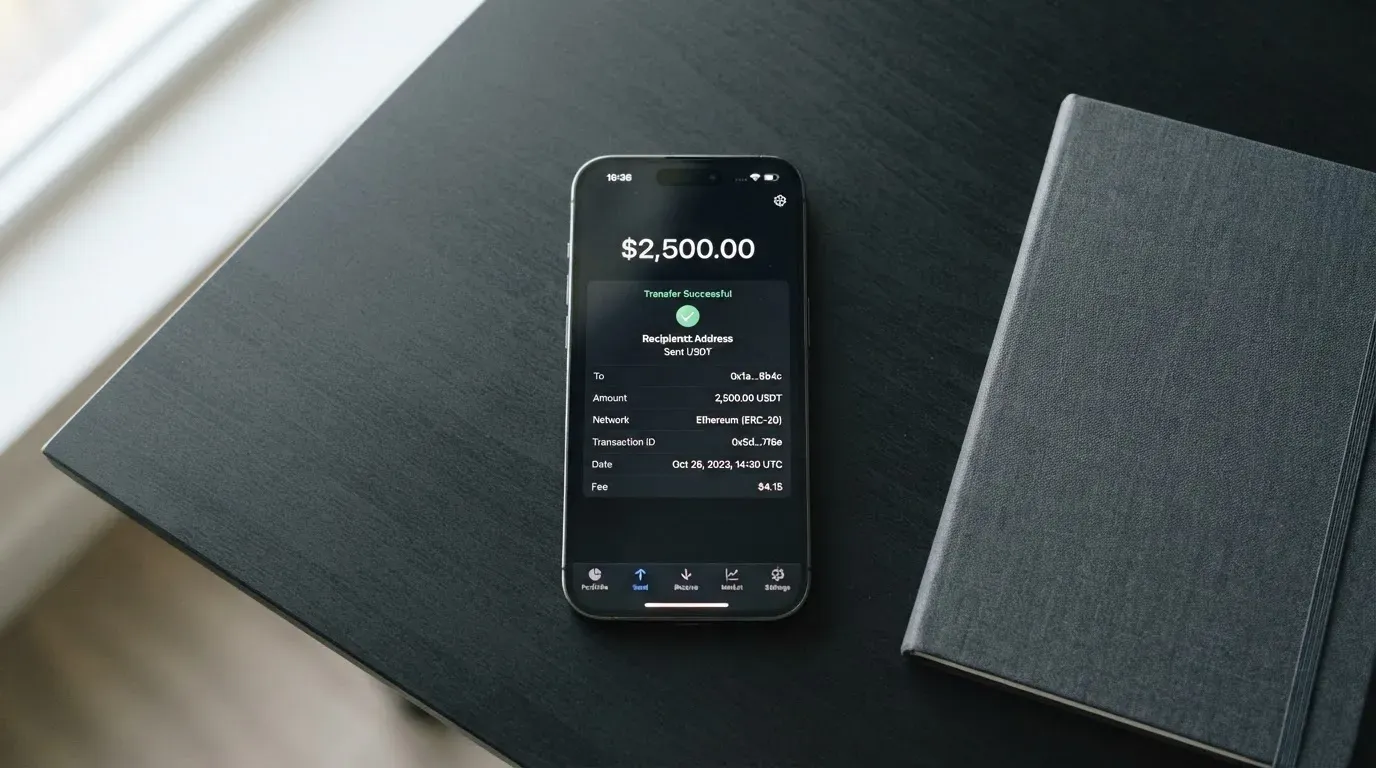
Two things to keep straight. Network fees are charged by the blockchain, not by the card — a general point about this whole category that applies to your deposit, not just to Kolo. One of the unsung facts of sending stablecoins: ERC-20 transfers are paid in ETH, so a wallet holding USDT but no ETH cannot send; Tron fees are paid via bandwidth and energy, often burning TRX. Send a little native token along with your stablecoin or the transfer simply stalls.
On the way out, the site says crypto can be sent to Revolut, Wise, N26 or any SEPA bank account, with no fees or limits given, and withdrawal-fee figures are not stated. What the terms do say is worth reading twice. From 1 July 2026 the model is non-custodial: Kolo cannot unilaterally transfer, seize or recall your assets, and on suspension or closure your recovery of your own key share is preserved (clause 11.2). The other half of that sentence is the one that stings: you stay liable for amounts due before closure (11.6).
Paying with it every day
Day-to-day, the card works through Apple Pay and Google Pay. That is the practical shape of using a virtual card: it is added to a phone wallet and tapped. Which merchant categories are blocked is not stated.
A word on why any of this can be declined, because it is a property of the category and it will save you assuming a bug. A payment card number starts with a 6- or 8-digit issuer identification number that tells the merchant which institution and country issued it, and a merchant may apply extra scrutiny when the issuer country differs from your billing address — which is why a card issued in one country can look foreign in another. Address Verification Service, which compares the numeric parts of the billing address you type against issuer records, is mainly offered in the US, Canada and the UK and is generally unavailable for foreign-issued cards, which can cause declines. And a declined authorisation can leave a hold on your funds for several days, typically up to seven.
On the rewards side there is a cashback programme: 2% in BTC for the first 30 days then 1%, capped at $2 then $1 per purchase and $100 per month. Read it against the terms. The Cashback Program is voluntary and discretionary, paid in digital assets, and may be changed or ended at any time without notice. It is a bonus, not a feature to plan around.
The app is on iOS, Android and a Telegram Mini App, downloadable at get.kolo.xyz. Store ratings and rating counts I could not read; the store pages were not reachable when I looked. If the rating matters to you, check it yourself in the store before installing.
Two rules in the terms that will shape your behaviour if you ever have a bad month. If a card transaction is disputed or charged back, the related cashback is cancelled or deducted (3.7), and Kolo may pursue losses from your chargeback with your bank, including acquirer and card-scheme administration fees and the value of the assets (12.4). Orders for digital assets are final, non-cancellable and non-refundable (10.1–10.2). There is a 14-calendar-day right of withdrawal from the agreement after account acceptance (clause 7), by email to [email protected]. The process and time frames for disputing a card payment specifically are not stated.
What can go wrong
Reliability is the weak point, and it is where I would want you to look hardest. The user-report figures differ slightly between reads — Trustpilot summarised by a third party as 3.9/5 from 52 reviews, and read directly as 3.7/5 from 54 reviews, of which 16 in the last twelve months, with 79% five-star and 17% one-star, and no reply from Kolo to negative reviews. Take the lower figure as the honest one. The recurring themes are consistent and they are all about money: withdrawals blocked or not completed with support silent (November and December 2025, February, May and September 2026); accounts or wallets closed without explanation (January, May and June 2026, one report from Zimbabwe); verification problems lasting weeks and repeating (November 2025), and an Indonesian ID not accepted (September 2026); and a card that could not be added to a phone wallet (December 2025). On the positive side, fast Telegram support is also reported (September and November 2025). Some reviewers allege fake positive reviews; that is unverified, and I mention it only so you do not read the five-star share as settled.
Underneath that sits a company story that has moved three times in a year. Officially: since 1 July 2026 all services are provided by Hardline Holding Limited, Kazakhstan, company number 221240900259; before that by BURVIX SP. Z O.O. (January to June 2026) and earlier Cryppo UAB (to 2025). Card Services are in collaboration with Signify Holdings Inc (Rain). The card issuer, BIN sponsor and licences are not named, and licences and fines are not stated. The site claims MiCA compliance and ten million users — self-reported, and worth treating as such. Note the date those claims become meaningful: MiCA’s transitional period let providers operating under national law continue only until 1 July 2026 or until they received or were refused authorisation, whichever came first. This is the moment Kolo’s operator changed and the wallet became non-custodial. I am not going to draw a conclusion the documents do not support; I am saying the timing is not a coincidence worth ignoring, and that you can check authorised providers on ESMA’s interim register.
On security, the terms for the non-custodial model are genuinely the strongest thing here. From 1 July 2026 the wallet is secured by MPC key shares: you hold one share, required for every transaction; Kolo holds another and may decline to co-sign for legal or risk reasons; the recovery process is preserved; and Kolo does not charge storage fees. The site adds two-factor authentication for login and withdrawals, “Fraud Shield” real-time AML and risk checks, Sumsub KYC, and claimed MiCA and Travel Rule alignment. In-app card freeze, spending controls and insurance are not stated. The honest framing of MPC: control of crypto belongs to whoever holds the private key, and a non-custodial setup means a compromise at Kolo cannot simply take your funds — but it also means you bear sole responsibility for key loss, phishing, and clipboard-hijacking malware that swaps an address you copied. Transfers are typically irreversible, and a stolen key has no recovery path.
Support and legal contact: email [email protected], which is also the address for limit-raise requests and formal notices; a Telegram channel and Mini App at t.me/kolo; legal notices to Astana, Esil district, 55/18, Mangilik El, office 218.
One more risk worth naming, because it belongs to the category and has happened repeatedly: programmes close. Visa terminated its global agreements with FTX in November 2022 and the card was wound down. WaveCrest, a Visa issuer that supplied crypto card brands, was suspended by Visa in Europe in 2018, closing all its Visa programmes. Closures typically mean a notice period, then loading and spending stop, then you are asked to withdraw. You are not signing up for something permanent, and the right posture is to hold only what you need.
What to take instead
I looked at three alternatives so the comparison is not one-sided. All scores are mine on the same basis as Kolo’s.
| Card | Score | Card type and cost | Who it is for |
|---|---|---|---|
| Kolo | 6.4 / 10 | Virtual (unofficial); issuance and monthly fee not stated officially | Anyone crypto who accepts an unclear fee picture and a company that has moved three times |
| MetaMask | 7.1 / 10 | Mastercard, Monovate; Virtual free, Metal $199/year | Someone who wants the fees stated plainly and will do without plastic |
| KAST | 6.1 / 10 | Visa Platinum/I Infinite, virtual and physical, up to 10 cards; Standard $0, Premium $1,000/yr, Private $10,000/yr | Someone who wants published limits, multiple card designs and stated cashback |
| Zeal | 6.1 / 10 | Visa, virtual, spend in 150+ countries; fees not published | Someone who wants to spend from a self-custody Safe and does not mind published-gaps |
MetaMask scores highest here, and the reason is disclosure. Sign-up is open in 45 listed countries and territories — Andorra, Argentina, Brazil, Canada, Mexico, Germany, France, Spain, Uruguay among them — with other regions on a waitlist; proof of residency is required; US and UK sign-ups are temporarily closed per the FAQ. “Ineligible regions limit sign-ups, not spending” is the sentence I would point to. The card is Mastercard from Monovate, with Crypto Life as card provider; a virtual card is issued instantly, metal can be pre-ordered in the app afterwards, one card per user. Virtual is free with no annual or maintenance fee; metal is $199 a year. Fees are described as a “minimal fee for each transaction” with “no additional MetaMask fees” and no foreign transaction fee, the Mastercard rate applying — the exact amount sits behind a linked table I did not read. It spends directly from your connected wallet on Linea, Base, Monad and Solana, from tokens including mUSD, wETH, EURe, GBPe, USDC and USDT, and cashback is paid in mUSD at 1% on Virtual. The catch is real: to get metal you buy the Metal tier.
KAST is the published-numbers option. Eligibility is residence-based and shown at KYC — if your country is not listed, KAST is not available there — and citizenship matters separately: living in a supported country with only an ID from a restricted region may still fail, though dual citizens with a supported-country ID may pass, and a VPN does not bypass this. Visa Platinum Standard, Visa Infinite metal Premium and Visa Infinite gold plated Private, plus Pengu, Solana and Bitcoin designs, up to ten cards, balance in USD with stablecoins converted 1:1 at 0% spread. Membership is $0 Standard, $1,000/year Premium, $10,000/year Private; Standard physical is 0 USD plus $40 delivery; an inactivity fee of $1/month starts after 12 months. Fees are unusually clear: 0% stablecoin top-up, 0% USD spend, 0% Apple/Google Pay, non-USD FX 0.5%–1.75% depending on residence, transaction country and programme, 0.10 USD on non-USD transactions under $25, 0.50 USD for a declined transaction. Cashback is 1.5% on the first $2,000/month (Standard), 2% on $10,000 (Premium), 3% on $40,000 (Private). You fund with USDT, USDC, PYUSD and RLUSD on Ethereum, Solana, Polygon, Arbitrum and Tron, no bank account needed.
Zeal is the self-custody option. Spend in 150+ countries, with issuance depending on eligibility and regional availability; the Gnosis Pay programme behind it is live in the EU, UK, Brazil, Colombia, Mexico, Japan, Singapore, the Philippines, Indonesia and Thailand. Visa, virtual card for online use, addable to Apple Pay, accounts in EUR, USD and GBP, spending from balances in a Gnosis Chain or Celo Safe. Zeal charges no additional FX fee and converts at the Visa wholesale rate, though Gnosis Pay fees such as ATM may still apply. Cashback up to 4%, paid in GNO on Gnosis Chain, which must be held in the card Safe to qualify, and the App Store advertises up to 5% variable APY on EUR/USD balances. Its weakness is the same one as Kolo’s: no fee schedule is published on the app site or the store.
The pattern across all four: none of these cards is permanent, all of them lean on the same networks, and the ones that publish their numbers (KAST, most of MetaMask) do so at the cost of either a membership fee or a narrower sign-up. Kolo sits at the open, cheap-to-enter end of that line and asks you to fill in the fee gaps yourself.
Who I would recommend it to
I would recommend Kolo to you if all three of these are true. You already hold crypto across several chains and want one card that will take it, because that is the part Kolo does better than anything else here — any crypto, seven networks, in-app swap, no bank account in the loop. You are comfortable treating it as a spend tool rather than a place to keep money, because the withdrawal complaints are real enough that I would not sit on a balance. And you have read the fee table above and made your own peace with the gaps, rather than expecting to reconcile them from the official pages — because they cannot be reconciled.
I would steer you elsewhere if any of these apply. If you want a fee you can read before your first purchase, take KAST or the MetaMask Virtual card. If you want to hold your own keys and spend from them directly, Zeal is built that way. If you are in the US or UK, MetaMask sign-ups are closed and Kolo’s own country coverage is the thing to check first. If cash machines matter to you, note that on current reports the ATM is on the physical card, and the physical card has no published ordering schedule. And if what you need most is the opposite of what Kolo offers — a card that looks entirely ordinary to a shop — none of these will do that job, and that is worth saying plainly rather than discovering at the till.
One last thing I will not do, because it would be irresponsible: tell you this is safe, or tell you what your tax position is. I can tell you what is published and what is claimed, and where those two have not met. Whether Kolo is safe for your money is a judgement you have to make from your own circumstances and your own reading of the terms. If you are in a position where tax matters, speak to someone qualified in your jurisdiction — the card cannot answer that for you, and neither can I.
Frequently asked questions
What is the Kolo card?
Kolo is a crypto payment card: you load it with cryptocurrency, it converts that into spendable balance, and you pay with it through Apple Pay, Google Pay, or the virtual card in the app. It is not a bank account, and the company behind it has changed hands three times since 2025, currently operating as Hardline Holding Limited in Kazakhstan.
How does the Kolo card work?
You fund the card with crypto — any crypto, with BTC, ETH, LTC, USDT and USDC named, across seven networks shown on the site, including Tron, Solana and Base — and it converts that into a balance you spend. Behind the card sits Signify Holdings Inc of Wilmington, Delaware (Rain cards), and the card’s own issuer and BIN sponsor are not named.
Is Kolo a bank?
No. Kolo is a card programme and a crypto platform, and the site claims MiCA compliance, but no banking licence is stated, and the card issuer, BIN sponsor and licences are not named. Treat it as a prepaid-style spend tool, not as somewhere to keep savings.
Who owns Kolo?
Since 1 July 2026, all services are provided by Hardline Holding Limited, Kazakhstan, company number 221240900259. Before that it was BURVIX SP. Z O.O. from January to June 2026, and earlier Cryppo UAB to 2025. Three operators in a year is worth knowing before you load funds.
Does Kolo require KYC?
Yes. Full identity verification runs through Sumsub, roughly a one-minute flow, plus two-factor authentication. Limits depend on how many verification steps you have completed, extra documents may be needed to raise them, and Kolo may refuse or later lower your limits. Proof of address and age requirements are not stated officially.
How much does the Kolo card cost?
Officially, a 1% fee on exchange orders plus network and bank costs, and “0% mark-ups on USDT, USDC, EURC” with no extra fee to convert crypto at payment. Issuance, monthly fees, conversion and FX are not stated officially; third parties report free virtual issuance, $0 monthly, and a 1% conversion fee on card payments.
Can I use Kolo in my country?
The site claims the service runs in 170+ countries and the card works in 60+; the terms bar anyone in, or national or resident of, Cuba, Iran, North Korea, Sudan, Syria and any sanctioned country or person. The country list is on the Kolo website, and Russia was not visible in the excerpt I read — check the list yourself rather than trusting a headline number.
Can I withdraw cash from the Kolo card?
Unofficial reports say ATM withdrawals cost $1 plus 0.65%, capped at $500 per withdrawal and three per rolling 24 hours, with $0.60 for a balance inquiry or a declined attempt. Crucially, ATM access is reported to be on the physical card only, and no physical card ordering schedule is published — so this may not be available to you at all.
Is the Kolo card safe to use?
It is a real service with real users, but it carries genuine risks: an unnamed issuer, a year of operator changes, and Trustpilot reports of blocked withdrawals and unexplained account closures. The non-custodial wallet model since July 2026 helps, but any crypto card can be delisted, and Visa has terminated programmes before — so only hold what you need to spend.
Is the Kolo card worth it?
For loading any crypto from any of several networks into one spendable balance, yes — that is its strongest suit and where it beat the alternatives. For a card you can cost precisely in advance, no: Kolo publishes none of the fees that decide your daily spend, and third parties do not fully agree on them either.
*This review reflects conditions as reported on the dates checked. Fees, eligibility and features change; verify current terms directly with the provider before making decisions based on this page.*
Wallet cards – cryptocardsranked
Content created by the «cryptocardsranked» team