
Revolut card review
 Available in US

Revolut’s crypto card is a virtual payment card that draws on a Revolut account balance you can fund with fiat or crypto. It works as a prepaid-style debit: the app converts your chosen token or currency at the moment of payment, and the card settles in fiat at the merchant. If you already use Revolut for everyday banking in the UK or EU, the card is a natural add-on, and the setup is light. If you are outside the company’s footprint, or you want a card built around a self-custody wallet, it will feel narrow.
The conditions in this review are current as of October 28, 2026. I checked the card’s official pages and several third-party sources in October 2026; where the card’s own pages don’t say something, I have marked the gap, and where a number comes from a third party I have said so.
Verdict
Revolut earns 6.5 out of 10. It is a competent crypto card for people who already bank with Revolut, with a generous range of supported tokens and broad mobile-wallet support. The catch is geography: the product is only available in roughly 37 countries, with the United States and Canada excluded, and several emerging markets missing. Pricing is also layered: virtual cards are free, but exchange fees kick in above a modest monthly threshold on the cheaper plans, and weekend markups are real. Support for crypto-specific problems is reported as patchy.
| Criterion | Mark | Why it matters |
|---|---|---|
| Who can get it | 6 / 10 | Officially dependent on country and plan; unofficially about 37 countries, with the US, Canada, Russia, China and a long sanctions list excluded |
| Cost | 6 / 10 | Virtual card free on Standard, Plus and Ultra; a 1% fee on crypto exchange above £1,000/month on Standard, plus a 1% weekend markup |
| Top-up options | 8 / 10 | Card draws from a chosen crypto or fiat account with automatic fallback; reportedly 250+ tokens for spending and 30+ fiat currencies |
| Reliability and complaints | 7 / 10 | Strong Trustpilot score (around 4.5–4.6/5) with recurring complaints about sudden account closures and difficult disputes; crypto services in the EU sit under a separate MiCA-licensed entity |
| Everyday use | 6 / 10 | Virtual card, works in Apple Pay and Google Pay, ATM allowance varies by plan, but physical-card details and reward rates are thin |
| Total | 6.5 / 10 | A good card for Revolut’s existing EU and UK customer base; less compelling if you want a self-custody-linked card or live outside the supported footprint |
This is a card for someone who already keeps money in Revolut and wants to spend crypto without a separate wallet. If you do not bank with Revolut, the on-ramp friction (full KYC, plan upgrade for better terms) makes it less attractive than alternatives such as Bitpanda or Wirex, which are covered later.
Who will give you the card
Revolut does not publish a single, plain-language list of supported countries on the card page. The eligibility rule, as the card states it, is bound to the country where you hold a Revolut account, and the plan you sit on. Practically, that means you need a verified Revolut account first, and the crypto card attaches to it.
Unofficial industry aggregators put the available footprint at around 37 countries, including most of the EU and EEA, the United Kingdom, Australia, Japan, Singapore and New Zealand. A second aggregator lists 48+ countries. The two figures are not reconciled, and I have not seen Revolut’s full internal list. If your country is not in the table below, assume the card is not currently offered, even if you can open a Revolut account for other purposes.
| Region | Available | Restricted (no service) |
|---|---|---|
| Europe (EU/EEA) | Austria, Belgium, Bulgaria, Croatia, Cyprus, Czech Republic, Denmark, Estonia, Finland, France, Germany, Greece, Hungary, Iceland, Ireland, Italy, Latvia, Liechtenstein, Lithuania, Luxembourg, Malta, Netherlands, Norway, Poland, Portugal, Romania, Slovakia, Slovenia, Spain, Sweden, Switzerland | — |
| Asia-Pacific | Australia, Japan, New Zealand, Singapore | — |
| Americas | Brazil | Canada, Cuba, United States, (Belarus, Haiti, Nicaragua, Venezuela) |
| Other | United Kingdom | Belarus, India, Iran, Libya, Myanmar, North Korea, Russia, Sudan, Syria |
The 12 countries that aggregators mark as fully restricted are Belarus, Canada, Cuba, India, Iran, Libya, Myanmar, North Korea, Russia, Sudan, Syria and the United States. This list is not stated by Revolut and should be treated as unofficial. Some countries appear in one aggregator and not the other, so treat the boundary as approximate. If you are deciding whether to apply, the practical test is whether you can already open and verify a Revolut account in your country of residence.
A few other rules shape who can use the card. Revolut’s own pages say nothing specific about the card’s age requirement beyond the platform-wide 18+ rule. Plan restrictions matter: the card is attached to a personal account on a Standard, Plus, Premium, Metal or Ultra plan, and Revolut’s terms of business exclude Pro and Business accounts from linking the card. If you are a US citizen living abroad, you may technically hold an account, but the card itself is not available in the US.
How to get it
The official onboarding path is not laid out step by step on the crypto-card page. The pattern, judging from Revolut’s general account flow and what third-party sites describe, is:
- Download the Revolut app and create a personal account. The app is the only place the card is managed; there is no separate web signup.
- Complete identity verification. Revolut does not state what this means for the crypto card specifically. Third-party sites describe a full KYC flow: government ID, possibly a selfie, and source-of-funds questions for larger crypto transactions. Treat this as unofficial, because Revolut’s own pages don’t repeat it for the card.
- Open the crypto section in the app. Revolut offers a brokerage-style crypto service where you can buy, sell and hold tokens in-app; the card is bolted on to that.
- Order the virtual card. Revolut’s fee schedules list virtual cards as free on Standard, Plus and Ultra. A physical card is optional, and pricing varies by plan and region.
- Top up the card (see the Top up section) and start spending.
Physical-card delivery is not stated on the card’s own page. Third-party sources describe a tiered delivery model: paid shipping (around £4.99/€5.50) on Standard, paid on Plus, free express on Premium, free priority on Metal and Ultra, with replacements around £5/€6 on Standard/Plus/Premium and higher on Metal/Ultra. This is unofficial and the exact prices shift with the plan; check your app before you order.
What the card is, formally, is also lightly documented. Revolut describes it as a virtual crypto card linked to a Revolut account. The card’s network (Visa or Mastercard) and its settlement currency are not stated on the public page, though the company’s general card range runs on both networks. Third-party sources describe the card as a Visa/Mastercard prepaid debit, with the network depending on the region where it is issued; again, unofficial.
Fees
Virtual cards are listed as free on the Standard, Plus and Ultra plans in older fee-schedule PDFs; the current schedule is not on the public card page. That makes the headline price attractive, but the running costs are where the card earns or loses money for you. The numbers below mix what Revolut’s help pages state with figures from third-party aggregators; I have marked each clearly.
| Fee or limit | Standard | Plus | Premium | Metal | Ultra | Notes |
|---|---|---|---|---|---|---|
| Plan fee (monthly) | £0 | £3.99 / €2.99 | £7.99 / €7.99 | £14.99 / €13.99 | £55 / €60 | Plan price, not card price. Source: third-party aggregator, Aug 2026 |
| Virtual card issuance | Free | Free | n/a (Premium ships physical) | n/a | Free | Revolut fee schedule |
| Crypto exchange allowance | £1,000 / month | £3,000 / month | Unlimited | Unlimited | Unlimited | After the allowance, fair-usage fees apply |
| Fair-usage exchange fee | 1% | 0.5% | 0% | 0% | 0% | Above the monthly allowance (unofficial) |
| Weekend FX markup | 1% | 0.5% | 0% | 0% | 0% | Applied on top of the interbank rate (unofficial) |
| ATM allowance (free) | £200 / month | £200 / month | £400 / month | £800 / month | £2,000 / month | Crypto-card-specific ATM rules not stated by Revolut (unofficial) |
| ATM fee above allowance | 2% | 2% | 2% | 2% | 2% | Per aggregator, Aug 2026 |
| Daily ATM limit | £3,000 | £3,000 | £3,000 | £3,000 | £3,000 | Per aggregator, Aug 2026 |
| Card payment conversion (crypto→fiat) | No exchange fee for crypto transactions with the card | n/a | n/a | n/a | n/a | Revolut help page (German version) — fair-usage fees may still apply |
Note: the third-party aggregator gives monthly exchange allowances in pounds sterling; the same plan in euros may carry different figures. Plan prices also vary by region, so check your own app for the live number.
A few everyday examples show how the costs stack up.
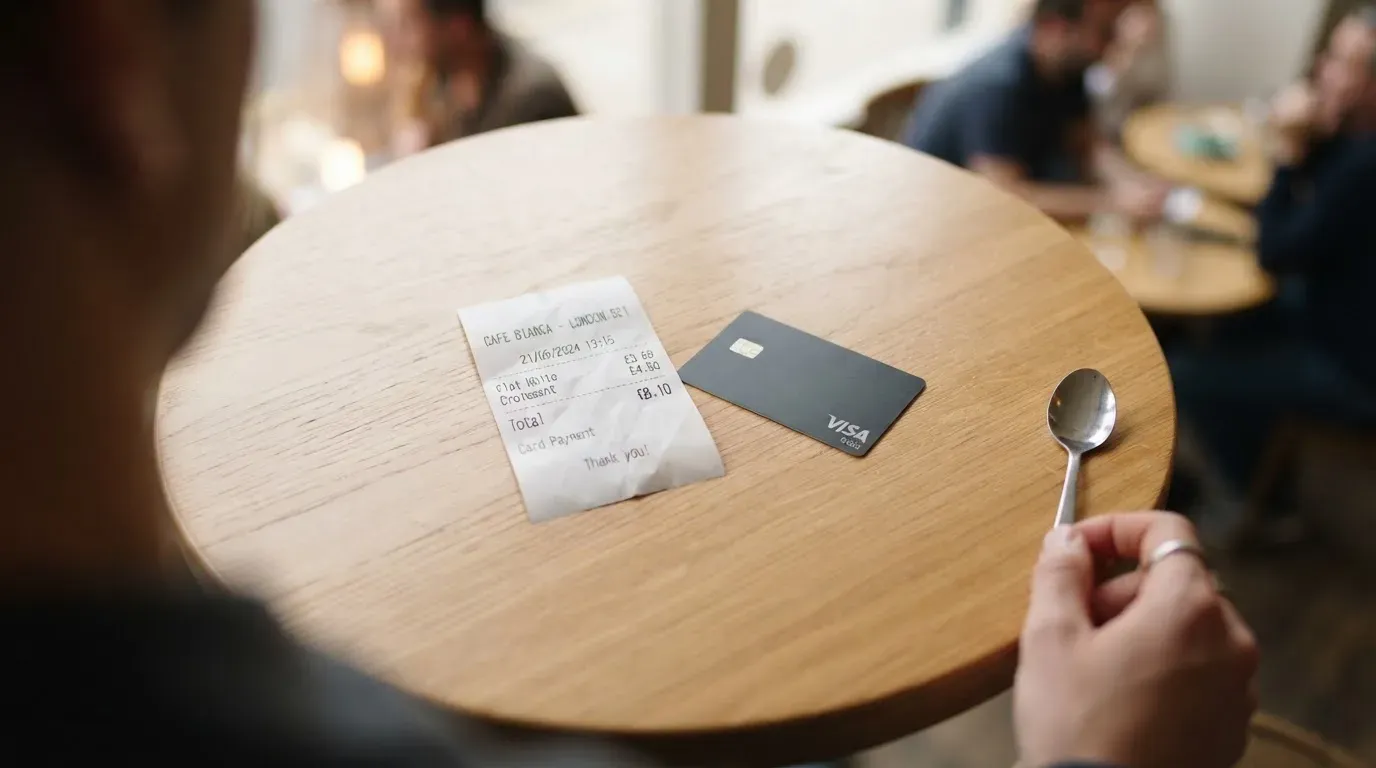
Paying for a coffee in London with BTC held in Revolut. Revolut converts bitcoin to pounds at the spot rate when you tap, and the merchant receives pounds. On Standard, if your monthly crypto-exchange volume is below £1,000, the conversion is free, but if you cross the threshold you pay 1% on the excess. If you buy the coffee on a Sunday, a 1% weekend markup is added on top. The total cost is the spread between Revolut’s quoted rate and the mid-market rate, plus any exchange or weekend fee that applies.
Paying for a hotel in Tokyo with EUR held in Revolut. Revolut converts euros to yen at the time of payment. The base conversion is free, but on Standard you can pay up to 1% in weekend markups if the booking falls on a Saturday. On Premium and above, weekend markups are zero, which is one of the clearest reasons to upgrade if you travel a lot.
Withdrawing £300 from an ATM in Spain on Standard. The first £200 in a month is free; the remaining £100 attracts a 2% fee, so £2.00 in ATM charges. These figures are unofficial and not confirmed by the card. On Ultra, the entire £300 is inside the free £2,000 monthly allowance and costs nothing.
Revolut’s official help text says there is no exchange fee for crypto transactions paid with the card, subject to fair-usage limits depending on your plan. The “no exchange fee” wording is a useful anchor: it means the basic act of paying in crypto does not, by itself, add a fee on top of the rate. The 1% or 0.5% on Standard and Plus is a fair-usage fee, not a per-transaction fee, and it only kicks in once you cross the monthly allowance. Older 2023 terms mention a separate crypto fee of 1.99% or £0.99, whichever is greater, on Standard and Plus; that wording does not appear in the current help text, but the per-month allowance model has carried over (these figures are unofficial and not confirmed by the card).
A few limits the card imposes: Revolut’s help pages state a 100-transaction limit on crypto exchanges per 24 hours, with minimum and maximum amounts depending on the coin. Third-party sources report a per-transaction ceiling around £100,000 and an exchange count of 200 per 24 hours; the two figures conflict, and Revolut’s own number is the authoritative one.
Top up
Revolut does not state, on the card’s public page, exactly how the card is funded. The mechanism described by third-party sites, and consistent with the app’s behaviour, is that the card draws from a chosen crypto or fiat account on the Revolut platform, with an automatic fallback to other Revolut balances if the primary account is short. There is no separate “card balance” to load in the prepaid sense; the card is a view on top of your existing Revolut account.
What that means in practice is that topping up starts with funding the Revolut account itself, then choosing which token or currency the card should pull from at the point of payment. You can, in principle, hold several currencies and tokens at once, and switch the spending source in the app.
| Funding path | What it covers | Notes |
|---|---|---|
| Fiat balance | 30+ fiat currencies | Top up via bank transfer, card or Apple/Google Pay in the app |
| Crypto balance | 250+ tokens (per third-party aggregator) | Available list not published on the card page; aggregator figure, Aug 2026 |
| Network on-chain deposit | Depends on token | The specific coins and networks the app accepts are not stated publicly |
Two things are worth flagging. First, the list of supported tokens is not published on the card page. If you hold a long-tail altcoin, the only reliable test is whether you can see it in your in-app crypto balance. Second, the card is not available to Pro and Business accounts, so if you are signing up to Revolut for business use and want the crypto functionality, you need a personal account as well.
A short note on networks and stablecoins is worth a paragraph here, because most crypto top-ups in 2026 happen via stablecoin transfers rather than bank transfers. Tether’s USDT and Circle’s USDC together account for about 90% of the stablecoin market by capitalisation, and USDC in particular is native to more than 30 networks. The important rule is to send on a network the card provider actually supports, because blockchain transfers are irreversible and a wrong-network deposit may need manual support recovery, with no guarantee. Revolut’s help pages say the 24-hour exchange limit of 100 transactions and the per-coin minimums/maximums are the binding constraints, not the underlying network.
Paying with it every day
In day-to-day use the card behaves like a prepaid debit. You tap or insert, the app converts your chosen token to the merchant’s currency, and the merchant is paid in fiat. It is a virtual card by default; whether a physical version is available depends on the plan and region, and the official pages don’t itemise this clearly.
Mobile wallets are supported. Third-party sites describe Apple Pay and Google Pay integration, which is the practical way most people carry the card. Reviews on the App Store (around 4.8/5 from 140,000+ ratings) and Google Play (4.5/5) are high, and the company’s own Trustpilot page sits around 4.5–4.6/5 across roughly 425,000 reviews. The number is large, but the patterns underneath it matter for crypto users.
Rewards are not a strong reason to choose this card. Metal and Ultra carry a 0.1% cashback rate in eligible European countries, rising to 1% elsewhere, with the monthly cap set around one month’s plan fee. Standard, Plus and Premium have no cashback. The third-party aggregator describes the reward as “capped at roughly one month’s fee”, which is unusual; if you upgrade for cashback, run the numbers first.
App experience is the card’s quiet strength. Revolut’s app handles KYC, plan management, crypto trading, ATM controls, instant card freeze, spending analytics and dispute filing. The 24/7 in-app chat is offered in 100+ languages, although crypto-specific complaints are a recurring theme in user reports.
What can go wrong
The complaint patterns that show up most often in user reports are the ones to weigh before you commit.
Account closures without clear reason. This is the most common Trustpilot complaint theme. The pattern is a long-standing account that suddenly stops working, often after a larger crypto transaction, with the user struggling to get a specific reason from support. EU anti-money-laundering rules let an institution end a relationship if it cannot complete customer due diligence, so a freeze is often triggered by a missing document rather than a judgement call, but the customer experience is the same: a closed account, frozen funds, and a slow process to recover the balance.
Hard fraud and chargeback cases. Users describe cases where they were unable to get chargebacks for fraudulent online payments, even with what looks like clear evidence. The UK Financial Ombudsman has issued decisions touching on Revolut card payments to crypto platforms, including one (DRN-5705456) where no chargeback was owed on a scam payment because the platform itself was the destination rather than a fraudulent merchant. The general lesson: card chargebacks are a payment-network feature, not a guarantee, and crypto transactions are a known edge case.
Held crypto deposits. Reddit and forum posts include accounts of crypto deposits held for two and a half months or longer while compliance reviews them. The crypto exchange on Revolut is custodial, so funds sit on the platform’s side of the ledger until released. If a large amount is held in review, the user cannot spend, withdraw or move it.
Trustpilot rating and dispute friction. The headline score is good (around 4.5–4.6/5 from a very large review base), but the volume of complaints about account actions and dispute outcomes is meaningful. For a card you intend to use as your main spending tool, the risk of a sudden account freeze is a real cost to underwrite.
Regulatory picture. Revolut Ltd (UK) and Revolut Bank UAB (EU) handle the banking side; in the EU, crypto services run through Revolut Digital Assets Europe Ltd, a Cyprus-registered MiCA CASP. The PRA granted Revolut a UK banking licence with restrictions in July 2024. None of this is a problem in itself, but it explains why two regulators can be involved in a single complaint, and why resolution paths differ.
A practical risk to keep in mind: like most prepaid-style cards, an authorisation hold can stay on the balance for several days (often up to seven), even if the merchant releases the funds earlier. If you are running close to your monthly exchange allowance, a series of holds can briefly push you over the threshold and trigger a fair-usage fee.
What to take instead
The card market is wide enough that it is worth comparing Revolut with three close alternatives. The picks below are evaluated on the same scoring scale.
| Card | Score | Best for | Trade-off |
|---|---|---|---|
| Revolut | 6.5 / 10 | Existing Revolut EU/UK customers who want a virtual crypto card with broad token support | Limited country footprint; layered fees on cheaper plans; support complaints |
| Wirex | 6.7 / 10 | Users in 130+ countries who want a Visa or Mastercard with WXT cryptoback up to 8% on Elite | Cryptoback paid in WXT, not fiat; several MCCs excluded |
| RedotPay | 6.9 / 10 | Users in Asia-Pacific and Latin America, with USD or HKD Visa cards and explicit KYC and sanctions lists | Paid virtual-card issuance ($10) and physical-card issuance ($100); a long list of restricted countries |
| Bitpanda | 6.5 / 10 | Euro-area residents who want a physical Visa debit with up to 2% crypto cashback | Euro-only settlement; physical card only; residence rule excludes Bankident-verified users |
Wirex has the broadest geographic reach of the four and a generous cryptoback scheme (0.5% Standard, 3% Premium, up to 8% Elite), paid in WXT. The card is a Visa Signature debit on Metal and runs on Visa or Mastercard elsewhere. The catch is the reward currency and the long list of merchant category codes excluded from cashback, which includes gambling (MCC 7995), crypto purchases, money-services businesses, and several others. The fees page does not show a fixed FX fee, describing the rates as “market-leading” and viewable in the app, which is marketing language rather than a commitment.
RedotPay is more transparent about its rules. It publishes two lists: a KYC list (countries whose citizens cannot complete identity verification) and a card-issuance list (residency-based, 47 places). The fees are flat and visible: 1% transaction fee on the default currency, 1.20% on non-default currencies, a $10 virtual-card application fee and a $100 physical-card application fee. There is no monthly account fee. A 5 USD welcome reward is valid for 30 days and cannot be used toward the issuance fee. RedotPay Pro costs $12.90 monthly or $129 annually. On the negative side, card issuance is paid and the eligibility lists exclude large markets including the US, Canada, China, Russia and many others.
Bitpanda is the European alternative with a euro-only Visa debit. Account opening, monthly cost and first shipment are free; a reissue is €5.90 (€9.90 if lost or stolen), and additional physical cards are €10. Non-EUR FX is free at Bitpanda’s level, but Visa’s mark-up still applies. The card’s draw is its spending model: you pick a main asset (crypto, precious metal or EUR) with an optional fallback, and Bitpanda auto-converts to EUR at payment. The 1% body cashback rate is unreconciled with the page summary of “up to 2%”, so treat the higher figure with caution. Only euro-area residents can apply, and users verified via Bankident are explicitly excluded.
In practice, the choice comes down to geography and how you hold your crypto. If you are in the EU or UK and already use Revolut, the Revolut card is the path of least resistance. If you need a card outside Revolut’s footprint, Wirex is the broadest option. If you want a transparent fee structure and are happy to pay a card-issuance fee, RedotPay is the most explicit. If you want a euro-area debit and a clean spending model, Bitpanda is the most local.
Who I would recommend it to
I would recommend the Revolut crypto card if you already have a Revolut personal account in the UK or EU, hold tokens in the in-app crypto service, and want a single place to convert and spend without a second wallet. The virtual card is free, the in-app flow is fast, and the supported-token range is wider than most alternatives. Apple Pay and Google Pay support is the practical way to use it day-to-day.
I would not recommend it if your country is outside the roughly 37 covered, if you want a physical card as the default rather than the exception, or if you hold crypto in a self-custody wallet. Revolut’s exchange is custodial, so moving tokens in means trusting Revolut with the keys until the moment of spend. The fair-usage fees on Standard and Plus are modest but real, and the recurring complaints about account freezes mean you should not park life-changing sums in the platform.
If you are choosing between Revolut and the alternatives above, the deciding factors are: which country you live in, which fiat currency you spend in, and whether you prefer a card paid in fiat cashback or in a token like WXT. Revolut’s reward scheme is the weakest of the four for non-European users, while its in-app experience is the strongest.
Frequently asked questions
What is the Revolut card?
The Revolut card is a virtual payment card linked to a Revolut personal account. You can fund it from a fiat or crypto balance inside the app, and the card converts your chosen asset to the merchant’s currency at the moment of payment. It is part of Revolut’s broader banking and crypto app, not a standalone product.
How does the Revolut card work?
You hold a balance in the Revolut app, pick a spending source (a token, a currency, or a fallback), and the card settles in fiat at the merchant. Crypto is converted at the spot rate when you tap or pay online. The card itself is prepaid-style: it draws on a stored balance rather than overdrawing a bank account.
Is Revolut a bank?
In the UK, Revolut Ltd holds a banking licence with restrictions granted by the PRA in July 2024. In the EU, banking services run through Revolut Bank UAB in Lithuania. Crypto services in the EU sit under a separate entity, Revolut Digital Assets Europe Ltd in Cyprus, authorised as a MiCA CASP. So the answer depends on the service and the country.
Who owns Revolut?
Revolut is a private company, not listed on a public exchange. It was founded by Nikolay Storonsky and Vlad Yatsenko and is headquartered in London. Ownership is split between the founders, employees and external investors.
Is the Revolut card available in the United States?
No. The US is on the restricted list in third-party aggregators and is not a supported country on Revolut’s general card programme. US citizens resident in other supported countries may have access, but US-issued cards are not available.
Does the Revolut card require KYC?
Yes. Revolut’s onboarding is KYC-based, and third-party sources describe a full flow: government ID, a selfie and, for larger crypto transactions, source-of-funds questions. Revolut’s own pages do not detail the card-specific KYC, so treat the third-party description as unofficial.
How do I activate the Revolut card?
Activation is in the app. After you order a virtual or physical card, the app prompts you to confirm receipt (for a physical card) and then activates the card. There is no separate activation code, and the process is the same regardless of the funding source.
How do I add the Revolut card to Apple Pay or Google Pay?
Open the app, find the card, and choose “Add to Apple Wallet” or “Add to Google Pay”. The card tokenises into the device’s secure element. You can then pay at any contactless terminal that supports the relevant wallet.
Is the Revolut card safe?
The card uses standard safeguards: app-based 2FA, instant card freeze, 3-D Secure on online payments, and tokenised mobile wallets. The platform is regulated, with banking licences in the UK and EU and a separate MiCA authorisation for crypto services in the EU. The main risk is not technical but operational: account freezes and held crypto deposits, which several users have reported.
Is the Revolut card worth it?
It depends on your situation. If you are an existing Revolut customer in a supported country, the card is a free, low-friction way to spend crypto. If you are outside the footprint, or you want a self-custody card, the alternatives (Wirex, RedotPay, Bitpanda) are worth a closer look. The fair-usage fees and the customer-service complaint patterns are the two main reasons to pause.
App and neobank cards – cryptocardsranked
Content created by the «cryptocardsranked» team