
The free stablecoin Visa, tested against the fee table and the complaints
 Available in US
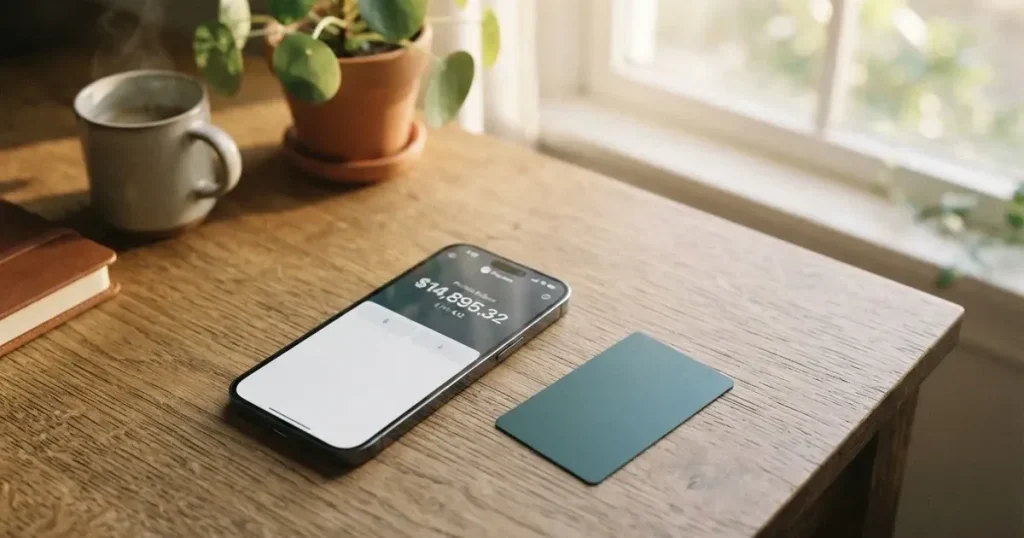
Wayex is a crypto card that behaves less like a bank account and more like a loaded travel card. You keep your balance in a dollar-pegged stablecoin, Wayex presents it as a Visa debit, and you spend from it like an ordinary card. The digital card is free, the account has no monthly fee, and spending in US dollars is quoted at 0%. That combination is genuinely rare, and it is why the card scores 7.5 out of 10 for me.
It is not, however, the finished product it is marketed as. Two things sit underneath the numbers and neither is resolved on the public pages: the card’s availability outside a handful of regions is not spelled out, and the fee table for the global Visa is incomplete. The pricing that is clear belongs to an Australian product with its own help centre; the pricing that would matter to you reading this outside Australia is often simply not stated. I have weighed the card on what is confirmed, and I have flagged every gap rather than filling it in.
This review is written for anyone, anywhere, who struggles to get an ordinary bank card. That includes people in countries without easy access to mainstream card issuing, people who hold crypto and want it spendable without going through an exchange again, and people who simply prefer a prepaid Visa over a bank account. If you are already well served by a mainstream bank card, read the fee table and the availability section first — if either looks vague to you, that vagueness is the point.
Conditions are current as of October 28, 2026.
Verdict: 7.5 out of 10
The card suits people who already hold stablecoins — USDT, USDC, DAI or PYUSD — and want them in Apple Pay or on a Visa without paying to open the account. It does not suit anyone who needs a physical card in a specific country today, anyone who spends heavily outside US dollars, or anyone who needs a clearly published foreign exchange rate. Those three gaps are not nitpicks: each one is a place where I could not answer from the public pages what would actually happen to the money.
| Criterion | Mark | Why |
|---|---|---|
| Who can get it | 5 / 10 | Live in 18+ regions today, expanding to 100+, but the regions are not named; citizens and residents of UN, FATF, EU and US sanctioned countries are excluded |
| Cost | 9 / 10 | Digital card free, account free to open, no monthly fees, 0% on USD spending; physical card price and FX outside USD are not disclosed |
| Top-up options | 9 / 10 | DAI, USDT, USDC and PYUSD across “10+ blockchains” (networks unnamed), plus fiat in USD, EUR and others |
| Reliability and complaints | 7 / 10 | Card issued by Lead Bank under Visa U.S.A. Inc. licensing, Bridge Ventures LLC runs the programme; Trustpilot 3.9 out of 5 across 61 reviews, with complaints about verification blocks and slow payments |
| Everyday use | 8 / 10 | Free digital Visa, physical card where supported, Apple Pay and Google Pay; ATM fees for the global card not disclosed |
| Total | 7.5 / 10 |
The reliability mark is the one that costs this card most. A cheap, well-funded-looking product is easy to like; the same product with a 3.9 TrustScore and a pattern of complaints about accounts frozen without explanation is harder to hand to someone as a main everyday card. Note what the complaints actually are, though: verification blocks, a delayed account closure, one slow five-euro transfer. Nobody in the sixty-one reviews describes a card that took their money and kept it. The pain is administrative, not financial — which is a different kind of risk, and a less serious one, though still an annoying one if you are relying on the card that week.
Will they give you the card?
Short answer: probably, if you are in one of the places it works, and definitely not if you live in or come from a sanctioned country.
The card’s own terms are clear about exclusions. You cannot be located in, be a citizen of, or be a resident of, a country sanctioned by the UN, FATF, the EU or the US (OFAC), nor of any jurisdiction that bars crypto services. That is a citizenship-and-residence rule, not merely an address rule, and it is stricter than some competitors: some cards screen where you live, this one also screens where you are from. If your passport says a sanctioned country, that is the end of it, regardless of where you currently reside.
Everything else is vaguer. Wayex says it is “live in 18+ regions today” and expanding to 100+, and that the app can be downloaded in 160+ countries. Neither number tells you anything actionable. The eighteen regions are not named anywhere on the pages I read, so I cannot tell you whether your country is one of them — and neither, from the same evidence, can anyone else. Downloadable is not the same as usable. That gap is exactly why the availability mark is 5 out of 10 despite the headline being so generous.
One unofficial data point, worth knowing and worth discounting: a third-party review site (CoinCodeCap, February 2026) reported that the core product is Australia only, with the 160-plus-country reach shown on the site as an early rollout. That is not confirmed by Wayex and it may be out of date. It is useful as a warning rather than a fact: assume your region is not on the list until you have checked, and ask before you move money.
Age is the one simple gate: you must be 18 or over.
How to get it
The card is a Visa Debit, described as prepaid. You start in the app, complete identity verification, and the digital card appears for you to add to a wallet. Wayex advertises “complete KYC in as little as 2 minutes” — as little as, which is marketing phrasing; treat it as a best case rather than a promise. The documents you will need are not specified on the public pages, so plan on having a government ID and something proving your address, which is the near-universal pattern for this category.
There are no card tiers to choose between on the main site. One card, one price, one set of features — a rarity that I appreciate.
The digital card is free. A physical card is offered “where supported”, and the main site says nothing about shipping or how long it takes. The Australian help centre is more forthcoming: physical card and delivery AUD 14.99, with a lost, stolen or expired card replaced free. Treat that as an Australian fact, not a global one. Countries and delivery times for the global card are not stated.
Your balance is held in USDB at a 1:1 rate to the US dollar — that is the unit the card spends from.
Fees and what a payment really costs
The headline pricing is genuinely good. A free digital card, an account free to open, no monthly fees, and “0% on USD spending”. That last one is the important phrase: zero applies to spending in US dollars, not to everything you do.
The gaps are where this becomes frustrating to read. The card’s own footer says only “Fees may apply.” The foreign exchange fee for non-USD spending is not stated. The crypto conversion fee — what it costs to turn your stablecoin into the balance the card spends — is not stated for the global card either. And no ATM fee is disclosed for the global product.
| Fee or limit | What Wayex states |
|---|---|
| Digital card issuance | Free |
| Physical card issuance | Price not stated on the main site; Australia help centre: AUD 14.99 including delivery |
| Account | Free to open, no monthly fees |
| USD spending | 0% |
| Non-USD spending / FX | Not stated for the global card; Australian help centre says no foreign exchange fees on Wayex, with AUD-denominated there |
| Crypto conversion | Not stated for the global card; Australian help centre quotes 0.40% down to 0.00% by 30-day trading volume |
| ATM | Not stated for the global card; Australia help centre: $0 Wayex fee, operator fees apply, withdrawals in Australia only |
| Daily / monthly limits | Global card: not stated. Australia help centre (page dated 29 Apr 2025): card spend max AUD 10,000 per transaction; crypto buy and sell AUD 100,000 per transaction and per day; minimum AUD 5 |
Two payments show why the omissions matter.
A $20 lunch in your home currency. If you pay in US dollars, the quoted rate is 0% on the card side. If the same lunch is billed in euros, pounds, Mexican pesos or Brazilian reais — the fiat currencies Wayex supports — then the foreign exchange rate is the thing you pay for your money, and that number is not published. Depending on the card network’s usual markup this can be a percent or two you never see itemised.
A dinner paid for out of stablecoins. If your balance is in USDT or USDC and the card converts to spend, the conversion fee is what you pay for turning crypto into fiat. The Australian product’s schedule runs from 0.40% down to 0.00% depending on your 30-day trading volume; I cannot tell you what the global card charges.
There is also a limit story that is unresolved. The Australian help centre says card spend is capped at AUD 10,000 per transaction. An unofficial third-party review (CoinCodeCap, reviewed February 2026, updated April 2026) reports a $1,000 per-transaction cap, $150,000 lifetime card spend before a free replacement, and $1,000 per day at Australian ATMs. Those two accounts contradict each other on the per-transaction figure, which is exactly why I am not presenting either as the answer.
One more pricing detail, and it is not a fee but behaves like one: Wayex advertises “Everyday Yield” of up to 5% on liquid stablecoin balances, which is live, and Fixed-Term Deposits of up to 20% via Kasu, which is coming soon. The 5% is a yield on holdings, not a cashback on the card — there is no card cashback stated anywhere.
How to Top up
Topping up is where Wayex is strongest. You can deposit DAI, USDT, USDC or PYUSD across “10+ blockchains”, and the networks are not named. You can also deposit fiat, with USD and EUR named and GBP, MXN and BRL listed among the on/off-ramp currencies.
The unnamed networks are the practical trap. On any chain, sending to the wrong network or to an address belonging to another one can lose the funds or send them into a manual support recovery with no guarantee — blockchain transfers are irreversible by design. Tether’s USDT exists on several chains, so “send USDT” is not a complete instruction; you need to send it on the network your deposit screen actually accepts. Check the deposit page in your own account before you send anything, and check it every time you switch network.
The Australian help centre (page dated 12 Aug 2026) is clear on the fee side: crypto deposits are free from Wayex, though the network or gas fee is charged by the blockchain and is not theirs; AUD deposits carry a zero fee; and there is no limit on deposits. The global minimum top-up is not stated.
Taking money out works the same way in reverse. Cash-out to fiat “where supported”, through PIX, SPEI, Faster Payments, SEPA, Wire or ACH, with ACH and Wire enabled. Fees and times are not stated on the main site. In Australia: crypto cash-out to a bank runs 0.40% down to 0.00% conversion by 30-day volume, AUD cash-out carries no fee, and crypto transfers out cost only the network fee. One line in the terms is worth reading carefully — “We may withhold withdrawals pending further investigation” — which is a standard compliance clause and also a sentence worth being sober about before you rely on this card for a payment you cannot afford to have delayed.
Paying with it every day
It is a Visa Debit, not a credit card. It spends what is on the card and cannot overdraw. Apple Pay and Google Pay are supported, which is the practical way most people will use it day to day, and both the iOS and Android apps exist. There is no cashback; the “up to 5%” figure is a yield on your holdings, a different thing that is easy to mistake for a reward.
The good news is that a Visa is a Visa, so the card works anywhere Visa is accepted — that is the whole point of the licensing arrangement, since the card is issued by Lead Bank under licensing by Visa U.S.A. Inc. and the programme is managed by Bridge Ventures LLC. Wayex itself describes itself as the platform provider and “not a bank”. That structure is normal for this category: the network routes the payments and sets the rules, the licensed issuer holds the card programme, and the crypto brand is the layer you actually interact with.
The friction to expect is the friction of a prepaid, foreign-BIN card, which is not the card’s fault but will still land on you:
- Some merchants decline prepaid cards or cards whose BIN country does not match the billing address, and the decline looks like a broken card rather than a policy.
- Address verification, which compares the numeric parts of the billing address against issuer records, is mostly a US, Canadian and UK service and is generally unavailable for foreign-issued cards. That produces declines that make no sense on the surface.
- A merchant category code classifies what a business sells, and while gambling codes are commonly blocked by policy rather than law, Wayex does not state a blocked-category list.
- A declined authorisation can leave a hold on your money for several days — typically up to seven — even when the payment never went through.
If a transaction goes wrong, the FAQ lists the question “What if I have a problem with a transaction” without answering it. The complaints policy gives what answers exist: acknowledgement within three business days, resolution within 30 business days. The terms put disputes to binding arbitration in Panama City, in English. No chargeback time frames are stated. If you are used to a bank card’s chargeback process, this is a real difference in how much standing you have if a payment goes wrong.
Support is where the card looks more generous. Live chat in the app or on the website, email at [email protected], and the help centre describes the support team as available 24/7. There are Telegram, X, Discord and Reddit channels as well. The help centre pages I read refer to Australian consumer-protection regulators — that is a separate Australian product, not a global assurance.
What can go wrong
The two structural risks are old and well known, and neither is specific to Wayex. The first is custody: with a custodial wallet the provider holds the credentials, so you have to trust them completely, and a seed phrase is an unencrypted key that anyone who obtains it can use to spend the funds. Custodial platforms have a real record of failure — Mt. Gox, Coincheck, Ronin Network among them — so holding funds with a custodian carries counterparty and hack risk. Wayex offers “transparent custody, and optional self-custody”, plus encryption, 24/7 monitoring and “Instant controls & alerts” on the card, which is a sensible set of controls, though two-factor authentication, card freeze and safeguarding details are not stated on the pages I read.
The second is the programme itself. Card programmes do close. Visa terminated its global agreements with FTX on 13 November 2022 and the FTX US debit card was wound down. WaveCrest, a Visa issuer that supplied crypto card brands, was suspended by Visa in Europe in 2018, closing all of its Visa programmes. The pattern when this happens is a notice period, then loading and spending stop, then users are asked to withdraw what is left. That is why I would not hold a large stablecoin balance here as a matter routine.
Then there is what actually shows up in the reviews. Trustpilot TrustScore 3.9 out of 5 across 61 reviews, read on 20 October 2026, with 74% five-star and 10% one-star. Trustpilot itself notes no recent review invitations. The complaints cluster in three places: account verification and blocks without explanation (May–June 2026), a delayed account closure where a user requested closure on 12 February 2026 and was still waiting on 26 May 2026, and slow payments including a five-euro transfer that took over ten days in March 2026. There were app sign-out bugs reported in October 2025. An earlier snapshot of the same reviews showed roughly 4.0–4.3 out of 5 across 53–56 reviews, so the score has drifted slightly downward. Praise runs the other way too: several reviewers cite support and the absence of FX fees. Wayex replies to all negative reviews, usually pointing people at private channels.
One one-star review from February 2026 calls it a crypto scam and describes losing about $20, with the company replying that the funds had arrived. No Reddit threads were found, and no official incident. I am not treating any single review as evidence — but a pattern of verification blocks is worth planning around, because it means the most likely thing to go wrong is your access, not your money.
Finally, the regulatory picture. The card is issued by Lead Bank under Visa U.S.A. Inc. licensing, with Bridge Ventures LLC as programme manager and disputes arbitrated in Panama City. Wayex’s own registration country is not stated. No dated licence events were found. In the EU, MiCA rules on stablecoins have applied since 30 June 2024, and e-money tokens may be issued only by a credit institution or an electronic money institution; the transitional period runs until 1 July 2026 at the latest. If you are in the EU, that is the framework your provider has to sit inside, and it is worth asking which licence applies to your account. If you are in the US, FinCEN treats administrators and exchangers of convertible virtual currency as money transmitters, while people merely buying things are not transmitters.
What to take instead
Three cards I looked at, each with a different bargain. None is clearly better than Wayex; each is better if a specific thing matters to you.
RedotPay — 6.9 out of 10. The most transparent of the three, and the most expensive to open. Virtual card application 10.00 USD, physical 100.00 USD and non-refundable once paid, virtual replacement 5.00 USD first then 10.00 USD each. The account maintenance fee is waived, so no monthly or annual charge. On top of that: a 1.00% transaction fee, 1.20% on non-default currency, small-auth and declined-payment surcharges after free allowances, and some merchants carrying an extra 1.5%. A paid tier, RedotPay Pro, costs 12.90 USD monthly or 129.00 USD annual. What you get for that is clarity — its KYC list actually names thirty-three countries, and a separate card-issuance list names forty-seven places where residents cannot get virtual or physical cards, covering Russia, Belarus, Ukraine and Serbia, with India, Indonesia, Morocco, Nepal, Singapore and Turkey added as of 28 August 2026. Funds arrive with an on-chain crypto deposit, and a 5 USD welcome reward is usable on spending for 30 days but not toward the issuance fee.
Bitpanda — 6.5 out of 10. The narrowest of the three, and the cheapest to hold. It requires a verified Bitpanda account and residence in a euro-area country, and users verified through “Bankident” cannot order a card — the rule is by residence, not citizenship, which is a softer test than Wayex’s. You get a physical Visa debit card in EUR only, one active card at a time. Account opening, the monthly cost and the first shipment are free; a reissue is EUR 5.90 (EUR 9.90 for lost or stolen), and each additional physical card is EUR 10. Non-EUR foreign exchange is EUR 0 but Visa mark-up fees apply, and the crypto conversion spread is not stated. It spends from a chosen main asset, converted to EUR at payment, with a EUR 1 minimum. The cashback figure is internally inconsistent: the body says 1% on crypto spending, the page summary says “up to 2%”, and fiat, stocks, metals and stablecoins are excluded.
Wirex — 6.7 out of 10. The widest footprint and the messiest pricing. Service area is stated as worldwide across 130+ countries, with fees published for the UK, EEA, APAC, Singapore, Australia and “Other”. You get one virtual card and one physical card at a time, Visa or Mastercard depending on region, plus a Visa Signature metal card for 45 GBP on the UK page with free DHL Express or a 45 EUR delivery fee elsewhere. Card issuance is free in those regions and PIN changes are free; the card page says “no annual or foreign exchange fees”, but the fee page does not specify an FX fee and instead points to the app, where the rate varies by pair and liquidity. Spending can use cash, stablecoins or cryptocurrencies; fiat deposits by SEPA, Faster Payments, ACH and PIX are free, though supported coins and networks for deposit are not stated. Cryptoback runs from 0.5% to up to 8% in WXT depending on tier, excluding ATM withdrawals, cash advances, crypto purchases, gambling, refunds and a long list of merchant categories.
Here is the comparison in one view.
| Wayex | RedotPay | Bitpanda | Wirex | |
|---|---|---|---|---|
| Score | 7.5 | 6.9 | 6.5 | 6.7 |
| Card cost | Digital free | Virtual 10.00 USD, physical 100.00 USD | Free, reissue EUR 5.90 | Free in listed regions; metal 45 GBP |
| Monthly fee | None | Waived (no monthly or annual fee) | None stated | None stated; one-off 30 GBP administrative fee possible |
| Main card currency | USD (balance in USDB at 1:1) | USD or HKD | EUR only | Not stated |
| Eligibility rule | Citizenship and residence, sanctions-based | Residence and citizenship screened differently on two lists | Residence in a euro-area country | Region-dependent, residence must match ID |
| Transparency of country list | Regions not named | 47 places named | Euro area named | 130+ countries claimed |
The honest summary: RedotPay tells you the most and costs the most to open, Bitpanda is the narrowest and calmest for a euro-area user, Wirex reaches furthest with the least clarity on fees, and Wayex is the cheapest to hold and the vaguest on both availability and global pricing. If the two things you cannot compromise on are a free card and a clear foreign exchange rate, none of the four gives you both, and that is worth sitting with before you choose.
Who I would recommend it to
I would recommend Wayex to someone who already sits on stablecoins, mostly in US dollars or in a currency where they can spend without thinking about conversion, and who wants a Visa in their phone wallet this week without a monthly charge hanging over them. If you are in a region where it is genuinely live, and you can afford to lose the balance you load, the card is a good deal on the terms it does publish.
I would not recommend it as your only card, for one specific reason: the thing most likely to go wrong here is access, not money. Accounts blocked during verification with no explanation, a closure request that sat for three months, a five-euro transfer that took ten days — none of those is catastrophic, but all of them are incompatible with depending on this card for a payment you cannot miss. Use it as a second card. Keep your everyday banking where you have a real dispute process and a real chargeback right.
Before you load anything, do three checks in this order. Check the deposit screen and confirm the exact network it accepts, because the “10+ blockchains” figure is not a network list and a wrong-chain transfer is usually gone. Check whether your country is one of the eighteen live regions, by asking support directly rather than trusting a download count. And check what the conversion and foreign exchange numbers are in your own account, because those are the two fees the public pages do not give you, and they are the two that decide whether the 0% headline means anything for you.
Frequently asked questions
What is the Wayex card?
Wayex is a crypto card that presents your stablecoin balance as a Visa Debit. It is prepaid rather than linked to a bank account: you top up, and the card spends what is loaded. The card is issued by Lead Bank under licensing by Visa U.S.A. Inc., Bridge Ventures LLC manages the programme, and Wayex describes itself as the platform provider and “not a bank”. It works as a normal Visa wherever Visa is accepted.
How does the Wayex card work?
You hold stablecoins — DAI, USDT, USDC or PYUSD — or fiat, on a balance denominated 1:1 to the US dollar as USDB. You spend from that balance with a Visa Debit card, added to Apple Pay or Google Pay. Because the balance is preloaded, the card cannot overdraw. Some crypto cards convert your crypto into a fiat balance at the top-up step rather than at each payment; Wayex’s exact conversion fee is not stated on the public pages.
Is Wayex a bank?
No. Wayex describes itself as the platform provider and explicitly not a bank. The card is issued by Lead Bank under Visa U.S.A. Inc. licensing, and Bridge Ventures LLC is the programme manager. That arrangement is standard in this category: the crypto brand is the front end, a licensed issuer holds the card programme, and the network routes the payments. Wayex’s own registration country is not stated on the public pages.
Who owns Wayex?
The card programme is owned and operated by Bridge Ventures LLC as programme manager, with Lead Bank as the issuing bank under Visa licensing. Wayex itself is the platform brand. None of these three is the same thing: Bridge Ventures runs the card, Lead Bank issues it, and Wayex is the app you use. Reviews tend to blur them, which is part of why complaints can be hard to direct at the right party.
Is the Wayex card free?
The digital card is free, and the account is free to open with no monthly fees. Spending in US dollars is quoted at 0%. What is not published is the price of a physical card on the main site — the Australian help centre lists AUD 14.99 including delivery, with free replacement for a lost, stolen or expired card — and the foreign exchange and crypto conversion fees on the global card. The footer says only that fees may apply.
Does the Wayex card require KYC?
Yes. Wayex advertises “complete KYC in as little as 2 minutes” and requires applicants to be 18 or over. The documents required are not specified on the pages I read. The terms also bar anyone located in, or a citizen or resident of, a country sanctioned by the UN, FATF, the EU or US (OFAC), or of a jurisdiction that bars crypto services — that is a citizenship rule, not just an address one.
How do I top up the Wayex card?
You deposit DAI, USDT, USDC or PYUSD across “10+ blockchains” — the networks are not named — or you deposit fiat in USD, EUR and other listed currencies including GBP, MXN and BRL. The Australian help centre states crypto deposits are free from Wayex with only the blockchain network fee applying, and no limit on deposits. Always confirm the exact network on your own deposit screen first: a transfer on the wrong chain is irreversible and may be unrecoverable.
Where can I use the Wayex card?
Anywhere Visa is accepted, in principle — it is a Visa Debit. The practical limits are the prepaid and foreign-issuer ones: some merchants decline prepaid cards or cards whose issuing country differs from the billing address, and address verification is generally unavailable for foreign-issued cards. Cash withdrawals: the Australian help centre covers ATMs in Australia only with a $0 Wayex fee and operator fees applying, capped at AUD 1,000 per day; nothing is stated for the global card.
Is the Wayex card safe?
It has the usual safeguards plus a clear custodial posture: “transparent custody, and optional self-custody”, encryption, 24/7 monitoring and instant card controls and alerts. Details on two-factor authentication, freeze and safeguarding are not stated on the pages I read. Weigh it against the structural risks: custodial providers have failed before, and card programmes have been closed — Visa ended FTX’s agreements in November 2022 and WaveCrest’s European Visa programmes closed in 2018.
Is the Wayex card worth it?
Worth it if you hold stablecoins and want a free digital Visa without a monthly fee. Not worth relying on as your only card, because the recurring complaints on Trustpilot (3.9 out of 5 from 61 reviews) are about verification blocks, delayed closures and slow payments — access problems, not lost money, but still bad if you depend on the card that week. Start small, keep a second card, and check the conversion and FX fees in your own account first.
App and neobank cards – cryptocardsranked
Content created by the «cryptocardsranked» team